
Grandparent Scam: How to Spot a Fake Grandkid Call and What to Do
 ·
Published
·
20 min read
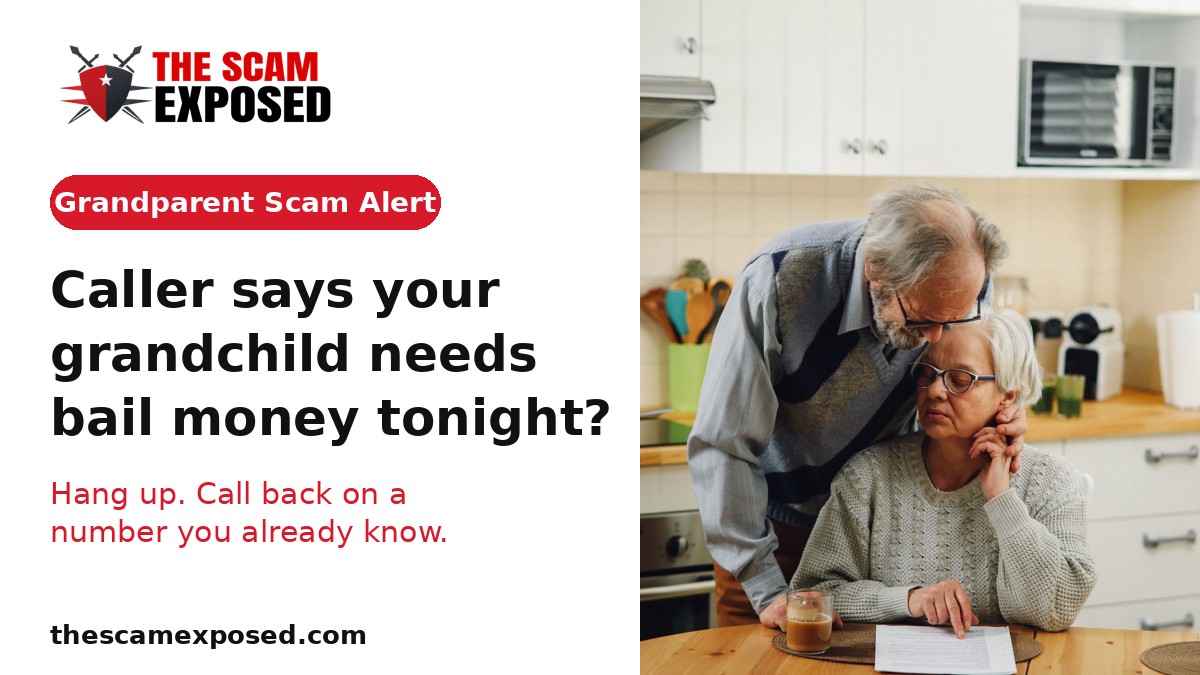
Short answer: In a grandparent scam, a caller pretends to be your grandchild, or a lawyer or police officer speaking for them, and says they need money right now for bail, a crash or a hospital bill. The voice may even sound real. Hang up, call your grandchild or another family member at a number you already know, and never pay by wire transfer, gift card, payment app, cryptocurrency or cash handed to a stranger.
The phone rings late in the evening. A young voice, crying a little, says "Grandma, it's me. I'm in trouble. Please don't tell Mom." Then someone else comes on the line, a "lawyer" or a "sergeant," and explains that your grandchild needs bail money tonight. Every part of that call is designed to make you act before you think.
At The Scam Exposed, this is one of the calls readers describe most often, especially around the holidays when families are traveling and phones are busy. The questions we hear are simple: "How could it sound exactly like him?" and "I already sent the money. What now?"
This guide explains how the grandparent scam works today, including fake voices made with AI, the warning signs, a simple family plan that stops it, and exactly what to do if you already paid. Every fact here comes from official sources, mainly the Federal Trade Commission (FTC) and the FBI Internet Crime Complaint Center (IC3). Sources are linked where they are used.
Key takeaways
- The FTC renewed its warning about grandkid scams on November 18, 2026, noting that scammers may clone a loved one's voice or even fake a video call.
- The emergency is usually bail, a car accident or a hospital bill, and the caller asks you to keep it secret.
- A familiar voice is not proof. Hang up and call your grandchild, or another relative, at a number you already have.
- No real lawyer, court or police department asks for bail by gift card, wire transfer, payment app or cryptocurrency, or sends a stranger to your door to collect cash.
- A family "safe word" that only your family knows is one of the simplest ways to check a caller. The FBI recommends it.
- Already paid? Call your bank or the payment company right away, then report it to ReportFraud.ftc.gov and IC3.gov.
On the phone with a "grandchild" right now? Hang up. You will not get them in trouble. Call your grandchild or their parents at a number you already have. If you already sent money, call your bank or the company you used to send it right away, then go to the step-by-step recovery section.
In this article (17)
- What a grandparent scam is
- How the call usually goes
- Why it can sound exactly like your grandchild
- What the official data shows
- Read a scam call line by line
- Other versions of the same scam
- Why careful people still fall for it
- Red flags checklist
- Real emergency vs scam call
- What to do while you are on the call
- Set up a family safe word
- How they ask you to pay
- Already paid? Do this now
- For adult children: how to talk to your parents
- An example of how it plays out
- FAQ
- How we researched this article
What a grandparent scam is
A grandparent scam, also called a family emergency scam, is a call, text or message from someone pretending to be a grandchild or another loved one in trouble. The goal is to get you to send money fast, before you have time to check the story.
According to the FTC's guide on fake emergency scams, the caller may also pretend to be a lawyer, police officer or doctor to sound more convincing. Scammers can pull personal details from social media or a hacked email account, so they may know names, where people live, or that your grandchild is traveling.
The FBI groups this scam with confidence fraud: any scheme that preys on your "heartstrings." It does not take a lot of technical skill. It takes a believable story, a scared voice and a short deadline.
Got a call from a number you don't recognize? Check the number for free against public FTC complaint records before you call back.
How the call usually goes
The details change, but the pattern is very consistent. Based on FTC descriptions, a typical call looks like this:
- The opening. "Grandpa? It's me." Many callers do not say a name. They wait for you to say it, then use it.
- The emergency. A car accident, an arrest, a hospital visit or being stuck far from home. The FTC says bail and car repairs are common stories.
- The second voice. A "lawyer," "public defender," "officer" or "bail bondsman" takes over and explains the amount needed and how to pay.
- The secret. "Please don't tell Mom and Dad. I'm so embarrassed." Or "There is a gag order on this case." Secrecy stops you from checking with anyone.
- The deadline. The money has to be sent tonight, or within the hour, or your grandchild "stays in jail."
- The payment. Wire transfer, gift card numbers, a payment app, cryptocurrency, or cash that someone will "pick up" from your home.
- The second call. If you pay once, the caller often comes back with a new problem: more fees, a fine, a damaged car. The second request is a strong sign the first was a scam.
Why it can sound exactly like your grandchild
For years, people were told to listen for a voice that does not sound right. That advice is no longer enough.
The FTC warns that scammers may use digital tools to clone a loved one's voice, and that some can use AI to copy a voice from a short audio clip. The FTC's November 2026 alert adds that if you are asked to join a video call, a face can be faked too. Short videos posted on social media can give scammers enough audio to work with.
Other tricks make the voice harder to judge:
- Crying or a "broken nose." The caller says they were hurt in a crash, which explains why they sound different.
- A bad line. Noise, echo or a "jail phone" make it hard to hear clearly.
- Your own words. When you say "Is that you, Danny?", the caller now has a name.
So the rule is simple: do not trust the voice alone. Check the story through a different phone number. Our guide on AI voice clone scams targeting older Americans explains the technology in more detail.
What the official data shows
These figures come from reports people chose to file. Many victims never report, often out of embarrassment, so real losses are likely higher. Each figure is labeled with the period it covers.
- In its 2025 Internet Crime Report, the FBI says victims claimed losses of over $5 million in 2025 to grandparent or "distress" scams where voice cloning was used to mimic a loved one. The FBI adds that this scam is evolving to mimic other family members or close friends in different emergencies.
- The same report shows that people 60 and older filed 201,266 complaints with IC3 in 2025, with $7.748 billion in reported losses, a 59% increase from 2024. This covers all scam types, not only grandparent scams.
- The FTC's November 2026 alert does not give a dollar figure for grandkid scams. It focuses on how they work and how to avoid them.
Why the numbers look small. The $5 million figure counts only distress scams where victims reported a likely AI connection. Grandparent scams without voice cloning fall into a broader FBI category, so there is no single official total for every grandparent scam. We do not estimate one.
Read a scam call line by line
Every line in a grandparent scam has a job. Once you see what each line is for, the call loses its power.
| What the caller says | What it is really doing |
|---|---|
| "Grandma, it's me." | Gets you to say a name, so the caller can use it. |
| "I was in an accident. My nose is broken." | Explains why the voice sounds different. |
| "Please don't tell Mom and Dad." | Stops you from calling the one person who could check the story. |
| "This is Officer Miller. Your grandson has been arrested." | Adds authority and fear. Real officers do not collect bail by phone. |
| "There is a gag order. You can't discuss this case." | A made-up legal reason for secrecy. |
| "The bail is $8,500 and it has to be paid tonight." | A deadline so you act before you think. |
| "Buy gift cards and read me the numbers." | A payment that is fast and very hard to reverse. |
| "A courier will come to pick up the cash." | No bank, no record. Real courts do not send couriers for bail. |
Other versions of the same scam
The FBI says this scam is evolving to mimic other family members or close friends in different emergencies. The story changes, but the shape stays the same: a loved one, a crisis, secrecy and a fast payment.
The text or social media message
Instead of a call, you get a text or a message: "Hi Mom, I dropped my phone, this is my new number. Can you help me pay a bill today?" The FTC notes scammers may use a hacked email account or details from social media to sound real. Call the old number you already have before you reply.
The "stuck while traveling" story
A grandchild is supposedly stranded on a trip, lost a wallet, or had a problem at a border. Holiday travel makes this believable. Ask where they are and call the parents. Real travelers almost always have someone else they can reach.
The hospital or "doctor" call
A "doctor" or "nurse" says your grandchild was hurt and treatment cannot start until a bill is paid. Hospitals do not refuse emergency care until a grandparent pays by gift card or wire. Call the family first, then the hospital using a number you look up yourself.
The friend or neighbor in trouble
The same script is used with a "friend," a "cousin" or a "nephew." If anyone you know asks for urgent money and secrecy, use the same steps: hang up, call them back on a number you have, and check with someone else.
Why careful people still fall for it
People who lose money to this scam are often careful with money in every other part of life. The scam does not target carelessness. It targets love and fear.
- Fear shuts down checking. When someone you love sounds hurt, your first thought is to help, not to question.
- Secrecy cuts you off. The FTC says scammers ask you to keep it secret so you panic and do not check the story with someone you trust.
- Authority feels real. A calm "lawyer" or "officer" makes the story sound official.
- Time pressure removes options. A one-hour deadline leaves no time to reach anyone.
- Shame comes after. Many victims do not tell family or report it, which is why the FBI and FTC both say real losses are likely higher than reported.
Knowing these tricks ahead of time is the best protection. When you feel rushed and scared on a money call, that feeling itself is the warning sign.
Red flags checklist
- An urgent call about a family emergency. Especially late at night or early in the morning.
- The caller does not say their name first. They wait for you to guess.
- A voice that sounds "off," with an excuse like a broken nose, a cold or a bad line.
- A request to keep it secret from parents or other family.
- A second person takes over, such as a lawyer, officer or bondsman.
- A deadline of tonight or within the hour.
- Payment by gift card, wire, payment app, crypto or cash pickup.
- A courier or "bail agent" offering to come to your home.
- A request to stay on the phone while you go to the bank or store.
- A second request for more money after the first payment.
One red flag is enough to hang up and check. You do not need to find all of them.
Real emergency vs scam call
| Real emergency | Scam call |
|---|---|
| You can call your grandchild or their parents back and reach them | The caller says you can't reach anyone else, or asks you not to try |
| Other family members usually know or can find out | The caller insists on secrecy |
| Bail is handled through a court, jail or licensed bail agent you can look up yourself | A voice on the phone tells you exactly how and where to pay |
| Normal payment methods with records | Gift cards, wires, payment apps, crypto or cash handed to a stranger |
| You have time to check | The money must be sent in minutes or hours |
What to do while you are on the call
These steps follow the FTC's advice: slow down and verify. You can do them even if you feel scared.
- Do not say a name. If the caller says "It's me," ask "Who is this?" and let them answer.
- Ask a question only the real person would know. The FTC suggests something personal, like the name of a pet or what happened at last Thanksgiving. Avoid anything that is on social media.
- Hang up. Say "I'll call you right back." A real grandchild will understand.
- Call your grandchild at a number you already have. Not a number the caller gives you.
- Call another family member, even if the caller begged you not to. The FTC says to do this.
- If they mention a jail or court, look up its number yourself and call to ask whether the person is there.
- Do not send anything until you have reached your grandchild or their parents directly.
It is okay to be rude to a scammer. Hanging up on a real grandchild costs a two-minute callback. Staying on the line with a scammer can cost your savings.
Set up a family safe word
The FBI recommends creating a secret word or phrase with your family to verify their identity, in its December 2024 warning about AI-enabled fraud. It takes five minutes and works even if the voice is a perfect clone.
- Pick something simple but private. Not a pet's name, street name or anything posted online.
- Share it in person or on a call you started, never by text or email.
- Tell everyone the rule: "If you ever call me asking for money in an emergency, I will ask for the word."
- Do not give the word to the caller. Ask them to say it. If they cannot, hang up.
- Change it if anyone outside the family may have heard it.
The holidays, when the family is together, are a good time to set this up.
How they ask you to pay
The FTC says grandkid scammers push you to pay by wire transfer, cryptocurrency, a payment app or gift card numbers. Some ask for cash. Each method is chosen because it is fast and hard to reverse.
Gift cards
No court, jail, lawyer or hospital accepts gift cards. If anyone asks you to buy gift cards and read the numbers, it is a scam. You can check with our gift card scam checker.
Wire transfers and payment apps
Money sent this way usually moves instantly. Some scammers ask you to stay on the phone while you send it, so no one at the bank or store can warn you.
Cryptocurrency
Some callers send you to a crypto ATM at a gas station or store. Real bail is never paid with crypto.
Cash by courier or mail
Some scammers send a "courier," "bail agent" or "driver" to your home, or ask you to mail cash. The FBI has warned that scammers use couriers to collect cash and precious metals from scam victims. Never hand cash to a stranger who comes to collect it for a family member.
Already paid? Do this now
Act fast and do not let embarrassment slow you down. These steps follow the FTC's guidance on what to do if you were scammed. Taking them does not guarantee you will get money back, but it gives you the best chance and limits further damage.
1. Stop further payments
If the caller calls back asking for more, do not answer or pay. A second request is common after a first payment.
2. Contact the company you used to pay
- Gift cards: Call the company that issued the card right away, tell them it was used in a scam and ask for a refund. Keep the cards and receipts. See our gift card recovery guide.
- Wire transfer: Call the wire company or your bank and ask them to reverse the transfer. See our wire transfer guide.
- Payment app: Report the payment in the app and contact the bank or card linked to it. See our payment app guide.
- Cryptocurrency: Contact the company you used to send it and ask whether it can be stopped. See our crypto guide.
- Cash by courier or mail: Call your local police right away, especially if someone came to your home. If you mailed cash, contact the shipping company and ask whether the package can be stopped. See our cash recovery guide.
3. Tell your family
Call your grandchild and their parents. They will want to help, and the scammer may try other relatives next.
4. Report it
- Report it to the FTC at ReportFraud.ftc.gov.
- File a complaint with the FBI at IC3.gov.
- If you are 60 or older, the National Elder Fraud Hotline at 1-833-FRAUD-11 (1-833-372-8311) can help you with reporting and next steps.
- Report it to your state attorney general.
5. Watch out for "recovery" calls
After a scam, you may hear from people who say they can get your money back for a fee, sometimes pretending to be police or a government agency. That is a second scam. Read more in our guide to the recovery scam that targets past victims.
These steps are for people in the United States. If you live elsewhere, contact your bank and your national fraud reporting service.
For adult children: how to talk to your parents
Grandparent scams work because people love their families. Being targeted says nothing about anyone's intelligence. A short, calm conversation helps more than a warning.
- Tell them it is okay to hang up on you. Many grandparents worry that hanging up will hurt a grandchild who really needs help.
- Agree on the safe word together.
- Give them a list of numbers for each grandchild and parent, on paper by the phone.
- Talk about social media. Travel posts and short videos can give scammers details and voice samples.
- Make it shame-free. If they ever get a call like this, or already paid, you want them to call you first, not hide it.
Our elder safety guides cover other scams that target older adults.
An example of how it plays out
The following is an illustrative example, not a real person. Ruth, 74, got a call at 10 p.m. A crying voice said, "Grandma, it's me. I hit someone with the car." Ruth asked, "Michael?" and the voice said yes. A man then came on as a "public defender" and said Michael needed $9,000 for bail before morning, and that a gag order meant she could not tell anyone.
The man asked Ruth to stay on the phone while she drove to the bank. Instead, she said she needed to find her glasses and hung up. She called Michael's mother at the number in her address book. Michael was home, asleep. Ruth then reported the number to the FTC. What helped her: hanging up and calling a number she already had. What would have helped even more: a family safe word, and not saying Michael's name first.
FAQ
What is a grandparent scam?
It is a call or message from someone pretending to be a grandchild or another loved one in trouble, or someone speaking for them, like a lawyer or officer. They ask for money fast and ask you to keep it secret.
Can scammers really copy my grandchild's voice?
Yes. The FTC warns that scammers may use AI to clone a loved one's voice from a short audio clip, and that a face on a video call can also be faked. Do not trust the voice alone. Hang up and call your grandchild at a number you already have.
How do I know if a grandchild is really in jail?
Hang up and call your grandchild and their parents. If you still need to check, look up the jail or court phone number yourself and call to ask. Do not use a number the caller gives you.
Would a lawyer or police officer ask for bail by gift card?
No. No court, jail, lawyer or police department asks for bail by gift card, wire transfer, payment app or cryptocurrency, or sends a courier to collect cash at your home.
What is a family safe word?
A private word or phrase that only your family knows. If someone calls asking for money in an emergency, you ask them to say it. The FBI recommends creating one to verify family members' identity.
I already sent money. Can I get it back?
Sometimes, if you act quickly. Contact the company you used to pay right away, such as the gift card company, wire service, payment app or bank, and ask them to stop or reverse the payment. Then report it to ReportFraud.ftc.gov and IC3.gov. Nobody can guarantee a refund.
Where do I report a grandparent scam?
In the United States, report it to the FTC at ReportFraud.ftc.gov and the FBI at IC3.gov. People 60 and older can also call the National Elder Fraud Hotline at 1-833-372-8311. Call local police if someone came to your home.
How we researched this article
This guide is based on the FTC consumer alert on grandkid scams (November 18, 2026), the FTC guide on fake emergency scams (September 2023), the FTC guidance on what to do if you were scammed, the FBI Internet Crime Complaint Center 2025 Internet Crime Report, the FBI public service announcement on generative AI fraud (December 2024), and the FBI public service announcement on scammers using couriers (January 2024). Figures are quoted as published by those agencies, represent reported complaints only, and are labeled with the period they cover. We did not find an official total for all grandparent scams in 2025, so we do not give one. The example of Ruth is illustrative and does not describe a real person. See our methodology and editorial policy for how we review sources. The Scam Exposed is an independent educational platform. We are not a government agency, law enforcement body, or legal advisors. Consult official channels for legal recourse.
Read next on this topic
 The Medicare Calls Hitting Seniors This Fall, and How to Shut Them DownRead guide →
 Calls Offering a Lower Credit Card Rate Want Your Money FirstRead guide →
 The 5 Scams Costing Older Adults the Most, According to the FBIRead guide →
 AI-Linked Investment Scams Cost $632 Million. Fake Videos Are One ToolRead guide →
 The NYPD Gold Bar Scam Took $100 Million From New YorkersRead guide →
 A Fake Grandchild Call Can Use an AI Copy of Their VoiceRead guide →
Share Your Experience
No one has commented yet. If this happened to you as well, say so below. Knowing that other people had the same call makes it far easier for the next person to trust their instincts.
Add Your Comment
Every comment is read by a person before it appears, so it will not show up straight away. Never post your phone number, address, or bank details here.