How to Spot Fake Holiday Stores, Deals and Delivery Texts
 ·
Published
·
20 min read
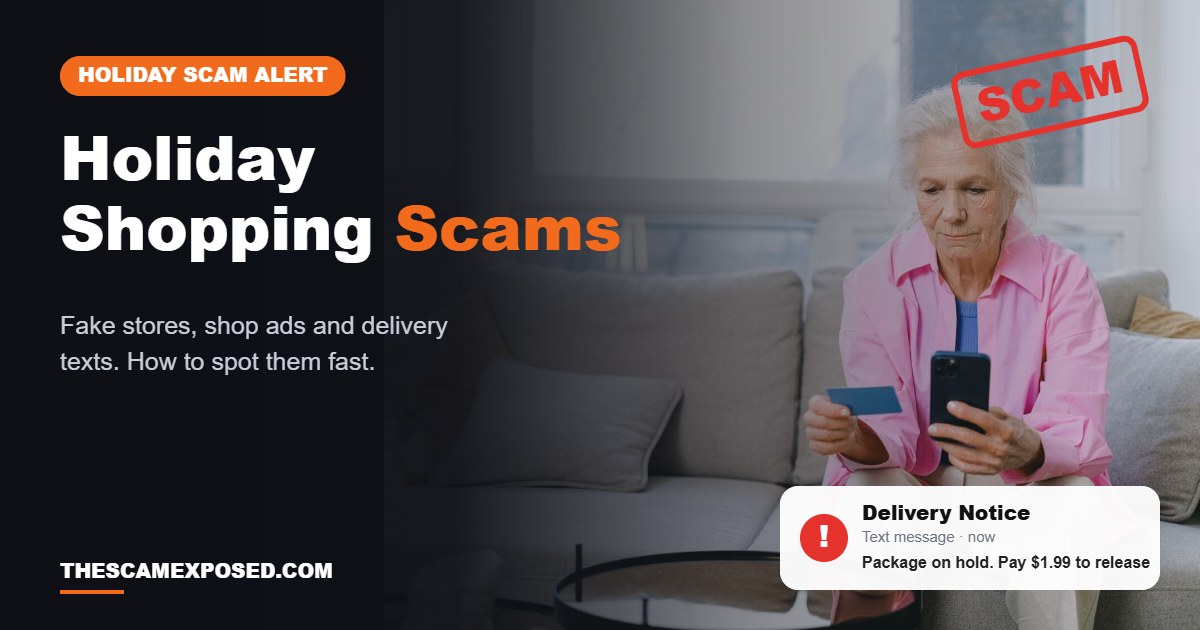
The holiday season is when most of us shop the fastest. We see a deal, we tap, we pay, and we move on to the next gift. Scammers know this. They build fake stores, fake ads and fake delivery texts that only need you to act for a few seconds without checking.
I run The Scam Exposed. Most of the year we focus on scam calls and texts. But the holiday season brings a different set of questions: "I ordered a gift and it never came. Was the store real?" or "I got a text saying my package is on hold. Is it safe to click?"
This guide covers the holiday shopping scams that show up most in official reports, how each one works, the warning signs, and exactly what to do if you already paid. Every number here links to its original source, mostly the FBI Internet Crime Complaint Center (IC3) and the Federal Trade Commission (FTC).
Key takeaways
- The FBI received 56,478 complaints about non-payment and non-delivery scams in 2025, with reported losses of over $503 million.
- People 60 and older filed 9,743 of those complaints and reported more than $127 million in losses.
- A store that only accepts gift cards, wire transfers, payment apps or crypto is a major red flag.
- Pay with a credit card when you can. The FTC says it gives you the best protection if something goes wrong.
- Never tap a link in an unexpected delivery text. Check your order in the store's own app or website instead.
- If you paid a scammer, call your bank or card company right away, then report to IC3 and ReportFraud.ftc.gov.
In this article (16)
- Why scams spike between Thanksgiving and New Year
- What the FBI numbers show
- Scam 1: Fake stores and too good deals
- Scam 2: Social media shop ads
- Scam 3: Fake delivery texts and emails
- Scam 4: Gift card payment and gift card draining
- Scam 5: Marketplace sellers, pets and tickets
- Scam 6: Fake fraud alerts from your bank
- The holiday scam calendar, week by week
- A real holiday season in the data
- Red flags checklist
- Real store vs scam store
- How to shop safely this season
- Already paid? Do this now
- FAQ
- How we researched this article
Why scams spike between Thanksgiving and New Year
Three things make the holiday season easy for scammers.
We expect deals. Black Friday and Cyber Monday train us to believe a 70 percent discount is normal. That makes a fake 80 percent discount feel only a little unusual, not impossible.
We expect packages. When you have five orders on the way, a text saying "your package could not be delivered" feels believable. You are not suspicious, because you really are waiting for something.
We are in a hurry. Holiday shopping comes with deadlines. "Order by December 15 for Christmas delivery." "Only 3 left." Scammers copy that same pressure. Hurry is the enemy of checking.
There is also more noise. Real stores send more emails, more texts and more ads in November and December than at any other time. When your inbox is full of real offers, a fake one blends right in. That is why the checks in this guide focus on habits you can repeat quickly, not on spotting perfect fakes.
None of these scams are new. What changes each season is the volume. More shopping means more targets, and the same old tricks work on more people.
Got a call or text like this? Check the number for free against public FTC complaint records before you call back or reply.
What the FBI numbers show
The FBI tracks shopping scams under a category called non-payment and non-delivery. Non-delivery means you paid and the item never came. Non-payment means you sold or shipped something and never got paid. Both are common during the holidays.
Here is what the FBI IC3 2025 Internet Crime Report shows for this category over three years:
| Year | Complaints | Reported losses |
|---|---|---|
| 2023 | 50,523 | $309,648,416 |
| 2024 | 49,572 | $785,436,888 |
| 2025 | 56,478 | $503,373,587 |
Source: FBI IC3 2025 Internet Crime Report, three year comparison tables.
Two things stand out to me. First, complaints went up in 2025, even though reported losses were lower than in 2024. Second, these are only the people who reported. Many shoppers who lose $40 or $80 on a fake store never file a report, so the real number is almost certainly higher.
Older shoppers are hit hard too. The same report shows that people 60 and older filed 9,743 non-payment and non-delivery complaints in 2025, with reported losses of $127,041,813.
These are full year numbers, not holiday only numbers. But the FBI has said directly that this type of fraud is a holiday problem. More on that in the real case section below.
Scam 1: Fake stores and too good deals
This is one of the most common holiday shopping scams. A website looks like a normal store. It has product photos, a logo, a "Holiday Sale" banner and a countdown timer. Prices are far below everywhere else. You order, you pay, and then one of three things happens:
- Nothing arrives at all.
- A cheap, fake or totally different item arrives.
- You get a tracking number that never moves, or shows delivery to the wrong city.
Many of these sites are built in a few hours and disappear after a few weeks. By the time you realize there is a problem, the site is gone and so is the contact email.
How to check a store before you buy
- Search the store name plus "scam" or "complaint." The FTC's online shopping guide recommends exactly this. If other shoppers have been burned, they often post about it.
- Look for a real address and phone number. A store with only a contact form or a free email address is a warning sign. The FBI lists "retailers using free email accounts instead of company addresses" as a red flag in its holiday scam alert.
- Check the price against big retailers. If a brand name item is half the price it is everywhere else, ask why. The FTC warns that expensive brand name items at bargain prices "could be counterfeit or stolen."
- Do not trust the padlock alone. The FTC says https and a padlock mean the connection is encrypted. It does not mean the site is legitimate. Scam stores use https too.
- Read the return policy. A real store explains how returns work. A scam store often has no policy, or a copied one with another company's name still in it.
For a deeper look at how these sites are built and the exact signs, read our full guide on how to identify and avoid a fake online store scam.
Scam 2: Social media shop ads
Many fake stores do not wait for you to find them. They come to you through ads on Facebook, Instagram and TikTok. The ad shows a product you might actually want, at a price that feels like a lucky find. One tap takes you straight to the checkout page.
The danger here is trust by association. You are on a platform you use every day, maybe right between posts from friends and family. The ad does not feel like a stranger on the internet. It feels like part of your feed.
The FBI's holiday alert specifically names "untrusted websites and social media ads with unrealistic discounts on brand-name items" as a top risk. It also warns about posts that appear to come from a friend, offering vouchers, gift cards, freebies or contests.
What to do instead of tapping
- Open a new browser tab and type the brand's official website yourself. If the deal is real, it will be there.
- Tap the advertiser name on the ad and look at the page. A brand new page with few posts and comments turned off is a warning sign.
- Read the comments under the ad if they are open. Scam ads often have replies like "never received my order."
We wrote a separate guide on how to check social media ads before you buy.
Scam 3: Fake delivery texts and emails
This one works because it fits perfectly into holiday life. You get a text like:
"USPS: Your package is on hold due to an incomplete address. Update here within 24 hours: [link]"
Or an email that looks like it is from a delivery company or a big store, saying a payment failed or a shipping fee is due.
The link takes you to a page that looks official. It asks you to "confirm" your address, then pay a small fee like $1.99 or $3.00. The fee is small on purpose. It feels harmless. But the real goal is your full card number, expiration date and security code. Once scammers have those, the small fee is the least of your problems.
The simple rule
Never tap a link in a delivery text or email you did not expect. Instead:
- Open the store's app or website yourself and check your order status.
- If you have a tracking number from the original order email, enter it on the carrier's official site, which you type yourself.
- Forward scam texts to 7726 (SPAM) so your carrier can block the sender, then delete the text.
The same trick shows up all year as fake toll texts. Our guide on the unpaid toll text scam shows the exact pattern, and our page on scam text messages covers the other versions.
Related: if a package shows up that you never ordered, that can be a different scam. Read what to do with a package you didn't order.
Scam 4: Gift card payment and gift card draining
Gift cards are a popular holiday gift, and scammers use them in two different ways.
Way 1: "Pay me with a gift card"
No real store, company or government agency will ask you to pay with a gift card. The FTC says this clearly in its online shopping advice: "Never buy anything from online sellers that insist you can only pay with gift cards." The same goes for wire transfers, payment apps and cryptocurrency.
Why do scammers love gift cards? Because once you read them the numbers on the back, the money is gone almost instantly and is very hard to trace or recover. The FTC has a full page on gift card scams with more examples.
If someone asked you to pay with a gift card and you want a second opinion, you can use our free gift card scam checker.
Way 2: Drained cards on the rack
Some criminals tamper with gift cards in stores before anyone buys them. They copy the card number and wait. When you load money onto the card, they spend it first. The person who gets your gift finds a card with a zero balance.
To lower the risk:
- Check the packaging. Do not buy a card if the back looks peeled, scratched or resealed.
- Buy from behind the counter when the store offers it, or buy directly from the brand's own website.
- Keep the receipt. You may need it if the balance is missing.
- Give the card soon, and suggest the person uses it soon.
Scam 5: Marketplace sellers, pets and tickets
Peer to peer marketplaces are full of real holiday deals from real people. They are also where many non-delivery scams happen, because there is no store standing behind the sale.
The FBI's holiday alert lists several patterns to watch for:
- Hard to find items. Event tickets, gaming systems and toys that are sold out everywhere else are perfect bait.
- Fake pet sales. A puppy or kitten for a low price, then a sudden "shipping fee," "vaccination fee" or "crate fee." The pet never arrives.
- Payment to someone else. A seller who posts under one name but asks you to pay a different person, or someone in another country.
- Unprotected payment methods. A seller who insists on a payment method that the payment company itself says does not protect purchases.
If you sell things online this season, the risk runs the other way too. The FBI warns about buyers who rush you to ship before payment clears, send fake "payment sent" emails, or overpay and ask you to send the difference to someone else. That last one is the same trick behind the fake check overpayment scam.
Scam 6: Fake fraud alerts from your bank
With more card purchases than usual, a fraud alert from your bank feels normal in December. Scammers take advantage of that. You get a text or call saying there is a suspicious charge on your account. The caller sounds helpful. They say they will "protect" your money, and then they ask you to move it, read them a code, or send money through Zelle to a "safe" account.
Your real bank will never ask you to send money to protect it. If you get an alert, hang up, and call the number on the back of your card yourself.
We cover this in detail in your bank will never ask you to move money through Zelle.
The holiday scam calendar, week by week
Scams follow the shopping calendar. Knowing what tends to show up when can help you stay one step ahead.
| Period | What shoppers are doing | Scams to expect |
|---|---|---|
| Early to mid November | Planning gifts, browsing early deals | Fake "early Black Friday" ads, fake survey rewards |
| Thanksgiving week to Cyber Monday | Buying the most, very fast | Fake stores, social media shop ads, fake order confirmation emails |
| Early to mid December | Waiting on many packages | Fake delivery texts, fake shipping fee emails, fake bank fraud alerts |
| Last shopping week before Christmas | Rushing for last minute gifts | Gift card payment requests, marketplace sellers, sold out item bait |
| After Christmas to New Year | Returns, gift card spending | Drained gift cards, fake refund messages, fake "return label" texts |
This calendar is based on the scam types the FBI and FTC describe. It is a guide to what to watch for, not a prediction.
Shopping for or with older parents
Many adult children help older parents with holiday shopping, and many older adults now shop online for grandchildren. Older shoppers are not less careful. But they are often targeted more, because scammers assume they have savings and may be less familiar with how fake stores and fake texts look.
A few simple habits help a lot:
- Agree on one rule as a family: nobody pays a store or seller with gift cards. Ever.
- Set up text alerts on their credit card so unusual charges show up right away.
- Offer to look at any "great deal" before they pay. A second pair of eyes stops most fake store purchases.
- Remind them that delivery companies and banks will not ask for card details through a text link.
Our guide on tech support scams targeting seniors covers another scam that often hits older adults during the holidays, when they set up new devices received as gifts.
A real holiday season in the data
In November 2023, the FBI published a public alert about holiday shopping scams. In it, the FBI looked back at the 2022 holiday shopping season and shared what victims had reported.
According to that FBI public service announcement, almost 12,000 people reported non-payment or non-delivery scams to IC3 during the 2022 holiday shopping season, with losses of over $73 million.
That is one holiday season, and only the people who filed a report. To put it simply: thousands of families paid for gifts that never arrived, or shipped gifts they were never paid for.
The scam types listed in that alert are the same ones this guide covers:
- A sold out item found on a site nobody has heard of.
- A "friend" sharing a voucher or free gift card link.
- An online survey that promised a reward and asked for personal details.
- A seller who wanted payment sent to a different name.
The lesson from the data is not that online shopping is unsafe. It is that the same handful of tricks work every year, and a few simple checks stop most of them.
Red flags checklist
- The price is far below every other store. Big discounts on brand name items are the oldest bait in online shopping.
- Payment only by gift card, wire, crypto or payment app. Real stores take credit cards.
- The site has no real address or phone number. Only a contact form or a free email address.
- The website was found through an ad, not a search. Especially a brand new social media page.
- A countdown timer or "only 2 left" pressure. Urgency is designed to stop you from checking.
- A delivery text you did not expect, with a link. Especially one asking for a small fee.
- Spelling mistakes or odd wording on the site. Or another company's name left in the policy pages.
- A seller who wants payment to a different person. Or who asks you to pay a "friend."
- A bank "fraud alert" that asks you to move money. Your bank will never do this.
The one rule to remember: if a store, seller or "bank" tells you to pay with a gift card, wire transfer, crypto or a payment app to a stranger, stop. That single request is enough to know it is a scam.
Real store vs scam store
| What to check | Real store | Scam store |
|---|---|---|
| Payment | Credit card, plus normal checkout options | Pushes gift cards, wire, crypto or app payment |
| Prices | Close to other big retailers | Far below everyone else |
| Contact details | Real address, phone number, company email | Contact form only, or free email address |
| Return policy | Clear and specific | Missing, vague or copied |
| Reviews | Mixed reviews across many sites | No reviews, or many "never arrived" complaints |
| How you found it | Search or known brand | Sudden social media ad or text link |
| Tracking | Updates normally on carrier site | Never moves, or shows another city |
How to shop safely this season
- Pay with a credit card. The FTC says "Paying by credit card best protects you and your money in case of a scam." If an item never arrives, you can dispute the charge.
- Use one card for online shopping. The FBI suggests a credit card dedicated to online purchases, so any fraud is easier to spot and stop.
- Type websites yourself. Do not reach a store through a text, email or ad link.
- Research unfamiliar stores. Search the name with "scam" or "complaint" before you pay.
- Save your records. Keep the order confirmation, the store's website address, the return policy and any messages. The FTC recommends this so you can prove what you were promised.
- Know the shipping rule. The FTC says that if a seller does not promise a shipping time, it must ship within 30 days of getting your order and payment.
- Check your statements. Look at your card activity every few days during the season, not once a month.
- Be careful on public Wi-Fi. The FBI recommends limiting public Wi-Fi use when you shop or bank.
- Talk to older family members. A short conversation about gift card requests and fake delivery texts can save a lot. Our free printable scam safety card can help.
Already paid? Do this now
If you think you paid a scammer, act fast. Speed matters most in the first hours.
- Call your bank or card company. Use the number on the back of your card. Tell them it is fraud and ask them to stop or reverse the payment. The FBI says to contact your financial institution immediately and ask it to contact the receiving bank.
- Dispute the charge in writing. For credit cards, the FTC says your written dispute must reach the card company within 60 days of the first bill that showed the charge.
- If you paid with a gift card, contact the gift card company right away using the number on the card or its official website. Tell them it was used in a scam and ask if the money can be frozen. Keep the card and the receipt.
- Report the payment app or platform. If you paid through a payment app or a marketplace, report the seller inside that app.
- Report to the FBI. File a complaint at ic3.gov, even if the amount was small.
- Report to the FTC. File at ReportFraud.ftc.gov.
- If you are 60 or older, or helping someone who is, call the National Elder Fraud Hotline at 1-833-372-8311 for free help with reporting.
- If you typed your card number on a fake page, ask your bank for a new card number, not just a dispute.
Our step by step help page walks through these actions in order, and you can report the store or number to us so other shoppers get warned.
Watch out for a second scam. After you report a loss, you may get calls or messages from people claiming they can get your money back for a fee. They may say they work with the FBI, the FTC or a "recovery firm." This is a recovery scam. Government agencies do not charge you to get your money back. Read more about why past scam victims are targeted again.
FAQ
What is the most common holiday shopping scam?
The FBI tracks most holiday shopping fraud as non-payment and non-delivery, where you pay for something that never arrives or ship something you never get paid for. In 2025 the FBI IC3 received 56,478 complaints in this category, with over $503 million in reported losses.
How can I tell if an online store is fake?
Search the store name with "scam" or "complaint," look for a real address and phone number, compare prices with big retailers, and read the return policy. Be very careful if the store only accepts gift cards, wire transfers, crypto or payment apps.
Is a website safe if it has a padlock and https?
No. The FTC explains that https only means the connection is encrypted. Scam stores use https too, so a padlock does not prove a store is real.
I got a text saying my package is on hold. What should I do?
Do not tap the link. Check your order directly in the store's app or website, or enter the tracking number on the carrier's official site that you type yourself. Forward the scam text to 7726, then delete it.
Why do scammers ask for gift cards?
Gift card money can be spent almost instantly once the scammer has the card numbers, and it is hard to trace or recover. No real store or government agency will ask you to pay with a gift card.
What is the safest way to pay online during the holidays?
The FTC says paying by credit card gives you the best protection, because you can dispute a charge for something you never received. Using one card only for online shopping also makes fraud easier to spot.
How long does a store have to ship my order?
Under FTC rules, a seller must ship within the time it promised. If no time was promised, it must ship within 30 days of receiving your order and payment.
Can I get my money back from a fake store?
It depends on how you paid. Credit card disputes give you the best chance. Call your card company right away. Recovery is harder with gift cards, wire transfers, crypto and payment apps, which is why scammers prefer them. Be careful of anyone who offers to recover your money for a fee.
How we researched this article
This guide is based on the FBI Internet Crime Complaint Center 2025 Internet Crime Report, the FBI IC3 holiday shopping public service announcement from November 2023, and the Federal Trade Commission's consumer guidance on online shopping and gift card scams. Figures are quoted as published by those agencies and represent reported complaints only. See our methodology and editorial policy for how we review sources. The Scam Exposed is an independent educational platform. We are not a government agency, law enforcement body, or legal advisors. Consult official channels for legal recourse.
Read next on this topic
 Why Past Scam Victims Are Being Targeted Again by a Second ScamRead guide →
 Free Scam Call Blocking From AT&T, Verizon and T-MobileRead guide →
 Five Phone Settings That Stop Most Scam Calls Before They StartRead guide →
 That E-ZPass Unpaid Toll Text Is Lying to YouRead guide →
 Rental and Real Estate Fraud Hit $275 Million. How to Spot ItRead guide →
 Before You Buy From a Sponsored Post, Check These SignsRead guide →
Share Your Experience
No one has commented yet. If this happened to you as well, say so below. Knowing that other people had the same call makes it far easier for the next person to trust their instincts.
Add Your Comment
Every comment is read by a person before it appears, so it will not show up straight away. Never post your phone number, address, or bank details here.