
Zelle Scam: The Fake Bank Fraud Alert That Tells You to Send Money
 ·
Published
·
18 min read
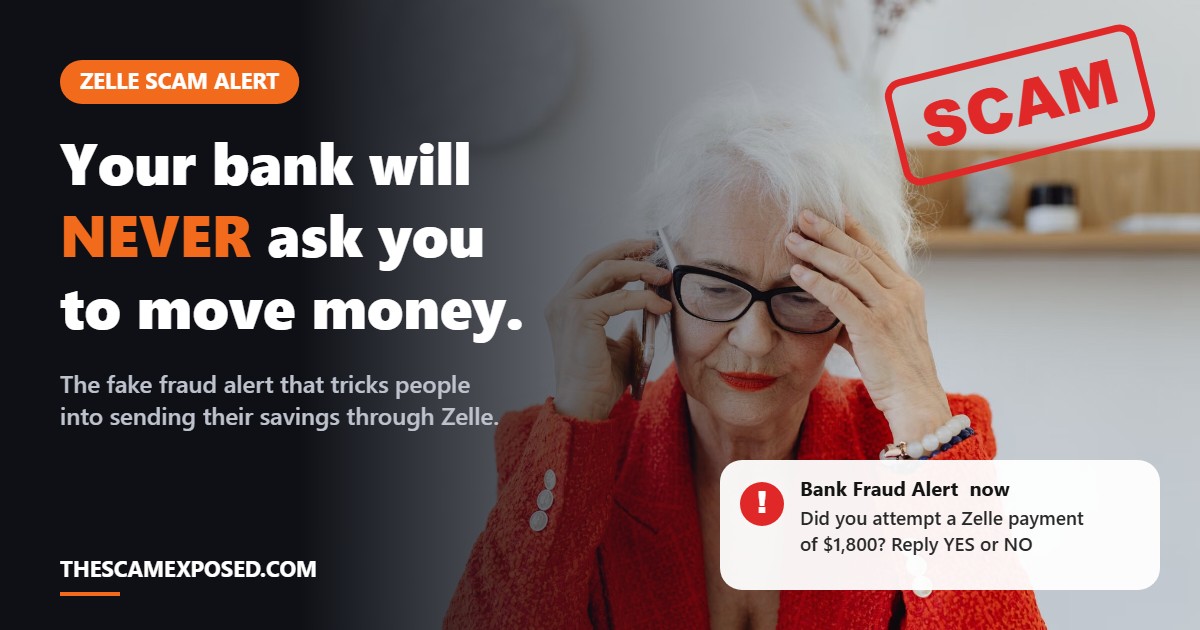
A text pops up from your bank: "Did you attempt a Zelle payment of $1,800? Reply YES or NO." You reply NO. A minute later your phone rings, the caller ID shows your bank's name, and a calm voice from the "fraud department" says they need your help to stop the thief right now.
That call is the scam. The person on the line is not stopping a fraud, they are running one. By the end of the call, many people have sent money through Zelle to an account they were told is "safe," or to their "own name," or to a "bank employee" who will "reverse the charge." The money goes straight to the scammer, and because the victim pressed send, it is very hard to get back.
I run The Scam Exposed, and fake bank fraud alerts are one of the scams I see most often in the complaints and messages we track. This guide walks through exactly how the Zelle version works, why it fools careful people, what the official data says, when a bank may refund you, and what to do in the first hour if you already sent money.
Key takeaways
- Your bank will never ask you to send money through Zelle to "protect" your account, "reverse" a charge, or move funds to a "safe account."
- The text and the call often come together. The text is just bait to make the call feel expected.
- Caller ID can be faked. Seeing your bank's name on the screen proves nothing.
- The FTC says people reported losing $470 million in 2024 to scams that started with a text, and fake fraud alerts were among the most reported types.
- If you sent money, call your bank using the number on your card right away and report it at ReportFraud.ftc.gov and ic3.gov.
In this article (14)
- How the scam starts
- The scam, step by step
- An example call
- Why scammers choose Zelle
- What the numbers show
- Why the caller ID shows your real bank
- Other versions of the same trick
- Red flags
- Your real bank vs the scam
- Will your bank refund a Zelle scam?
- How to protect yourself and your parents
- Already sent money? Do this now
- Common questions
- How we researched this article
How the scam starts
Most versions start with a text message that looks like a routine fraud alert. It names your bank, mentions a payment you did not make, and asks a simple yes or no question. Some ask you to call a number. Others just wait for your reply.
Replying NO feels like the safe thing to do. You are telling the bank the payment was not you. But that reply tells the scammer three useful things: your number is active, you believe the message came from your bank, and you are worried about a payment right now. That is the perfect moment for them to call.
Some versions skip the text entirely and start with a phone call. Others start with an email that looks like a Zelle or bank notice. The goal is always the same: get you on the phone with someone who sounds like your bank's fraud team.
The Federal Trade Commission lists fake "fraud alert" messages about a suspicious purchase or a problem with your bank among the most commonly reported text scams in its 2024 text scam data. We have covered other bank-themed texts in our guide to the 7 common scam texts.
Got a call or text like this? Check the number for free against public FTC and FCC complaint records before you call back or reply.
The scam, step by step
The details change from caller to caller, but the structure is almost always the same.
Step 1: The fake alert
You get a text or call about a suspicious Zelle payment, a large debit card purchase, or someone trying to log in to your account. The amount is usually large enough to scare you, often between $500 and $3,000.
Step 2: The "fraud department" calls
A caller says they are from your bank's fraud or security team. The caller ID may show your bank's real name or real phone number. They may already know your name, the last four digits of your card, or your address. That information often comes from old data breaches and is easy to buy.
Step 3: They "verify" you
To make it feel like a real bank call, they ask you to confirm who you are. They may ask you to read back a one-time code that was just texted to you. That code is often the real code your bank sends when someone tries to log in to your account or add a new device. When you read it to them, you are handing over access.
Step 4: The twist
Now the caller explains that the "thief" is still trying to take your money. To stop them, you need to act fast. This is where Zelle comes in. The caller says one of these:
- "Send the money to yourself so it is protected while we lock the account."
- "Send it to this secure account while we investigate."
- "Send the same amount to this number to reverse the fraudulent payment."
- "Send it to our bank employee, and it will be returned within 24 hours."
Sometimes they ask you to enter your own phone number or email as the recipient. The trick is that they have already linked your phone number or email to a Zelle profile under their control, or they quietly give you a different number to type in.
Step 5: More pressure, more payments
After the first payment, there is often a second "problem." The transfer "did not go through," or the thief is "trying again." People are walked through two, three or four payments before the call ends. Some are also told not to talk to bank staff at the branch because "the fraud may involve an employee."
Step 6: Silence
Once the money is gone, the caller hangs up or stops answering. When the victim calls the real bank, they often learn there was never any suspicious payment at all.
An example call
Here is a realistic example of how the call can sound. It is written from the common pattern of these scams and is not a recording of a real call.
Caller: "Hi, this is Daniel with the fraud prevention team. We just sent you a text about a Zelle payment of $1,800 to a Michael Ross. You replied that this was not you, correct?"
You: "Yes, I did not send that."
Caller: "Okay, I am glad you responded quickly. Someone has access to your online banking. I am going to send you a verification code to confirm I am speaking with the account holder. Please read it back to me."
Caller: "Thank you. I can see the person is trying another payment right now. To stop it, I need you to open your banking app and send your available balance through Zelle to your own phone number. That moves it into a protected status until we issue you a new account."
Caller: "Please do not hang up, and do not contact the branch. We believe this may involve someone inside, and I do not want to tip them off."
Every line is designed to feel helpful and urgent at the same time. And every instruction in it is something a real bank fraud team would never ask you to do.
Why scammers choose Zelle
Zelle is not the scam. It is a real payment network built into the apps of thousands of US banks and credit unions. Scammers like it for the same reasons people do: it is fast, it is already in your banking app, and most people trust it because their bank offers it.
Three features make it attractive to scammers:
- Speed. Money usually reaches an enrolled recipient within minutes. By the time you realize what happened, it may already have been moved again.
- Few take-backs. Zelle is designed for paying people you know and trust. Once a payment reaches an enrolled recipient, it generally cannot be canceled.
- It feels official. Because Zelle sits inside your bank's own app, a request to "send through Zelle" sounds like part of the bank's process.
The scale is large. According to reporting in Forbes, Zelle processed $1 trillion in 2024 across 151 million enrolled users. Even a very small fraud rate on that volume means a very large number of victims.
What the numbers show
There is no single official count of Zelle scam losses, but several public sources show how big the problem has become.
| Source | What it says | Period |
|---|---|---|
| FTC text scam data | $470 million reported lost to scams that started with a text. Fake fraud alerts were among the most reported types. | 2024 |
| CFPB lawsuit (as reported by Forbes) | Alleged that customers of the three largest Zelle owner banks lost more than $870 million to fraud on the network over seven years. The CFPB dropped the case in March 2025. | About 2017 to 2024 |
| New York Attorney General lawsuit (as reported by Forbes) | Alleges Zelle's design enabled more than $1 billion in fraud. The operator has moved to dismiss. | 2017 to 2023 |
| Senate letter cited by NBC News | Lawmakers estimated Zelle users lost $440 million to all types of fraud. | 2021 |
These figures measure different things and overlap, so they should not be added together. The lawsuit numbers are allegations, not court findings. What they agree on is direction: payment app fraud, much of it starting with someone pretending to be a bank, is measured in hundreds of millions of dollars a year.
The real number is almost certainly higher. Many people never report a loss, either because they feel embarrassed or because they assume nothing can be done.
Why the caller ID shows your real bank
This is the part that convinces most people. They look at the screen, see their bank's name or the exact number printed on the back of their card, and relax.
Caller ID can be faked. The technique is called spoofing, and it lets a caller choose what name and number appear on your phone. Phone carriers have added tools to flag spoofed calls, but they do not catch everything, especially calls that come through overseas networks.
So the rule is simple. A call that looks like it is from your bank might be from your bank, or it might not. The only way to know is to hang up and call the bank yourself using a number you already trust, such as the one on the back of your card or inside your bank's official app.
Many of the numbers people report for this kind of call show up in our impersonation scam call numbers report. You can also check any number with our free robocall checker.
Other versions of the same trick
Once you know the core move, "send money to protect money," you will spot it in several other disguises.
The "Zelle is frozen" email
An email that looks like it came from Zelle says your account is on hold until you "upgrade to a business account" or pay a small fee. A follow-up message then asks you to send money to unlock it. Zelle does not charge consumers to receive money and does not email you asking for payments.
The buyer who "overpaid"
If you sell something online, a buyer may claim they sent you too much through Zelle and ask you to refund the difference. Often no money was ever sent, and the "payment notice" was a fake email. Always check your balance in your banking app, not in an email.
The "send it to yourself" setup
In this version the caller never gives you a stranger's name. They tell you to send money to your own phone number or email. Before the call, the scammer has registered that number or email with Zelle at another bank, so your "transfer to yourself" lands in their account.
The utility or government twist
Some callers pretend to be your power company, a government office, or a tech support team instead of your bank. The ending is the same: a Zelle payment, gift cards or a wire, made right now to avoid a problem. We have seen the same pattern in the fake FTC call about deactivating your phone number.
Red flags
- They tell you to send money to protect your money. No real bank fixes fraud by asking you to make a new payment.
- They mention a "safe account" or "secure account." There is no such thing. This phrase is used almost only by scammers.
- They ask you to send money to yourself through Zelle. You cannot protect money by sending it to your own phone number. The number may be linked to the scammer's account.
- They ask you to read back a code. Banks send codes so you can prove it is you. They never need you to read that code to a caller.
- They tell you not to talk to the branch or anyone else. Secrecy protects the scammer, not you.
- They keep you on the phone. Real fraud teams are fine with you hanging up and calling back.
- A text asked you to reply YES or NO, then a call followed right away. The text was bait.
- The payment needs to happen "right now." Urgency stops you from thinking clearly.
The one rule to remember: If anyone tells you to move money to keep it safe, it is a scam. Hang up and call your bank using the number on your card.
Your real bank vs the scam
| Situation | Real bank | Scammer |
|---|---|---|
| Suspicious payment | Asks you to confirm it was you, then blocks or reviews it on their side | Asks you to send a new payment to "stop" or "reverse" it |
| Verification codes | Tells you never to share codes with anyone | Asks you to read the code back |
| Hanging up | Fine with you calling back on the number on your card | Pushes you to stay on the line |
| Moving money | Never asks you to move funds to a "safe account" | Insists on a "secure" or "protected" account |
| Branch staff | Happy for you to visit or call a branch | Tells you not to trust the branch |
| Payment method | Never asks for Zelle, gift cards, wire or crypto to fix fraud | Asks for Zelle, then sometimes gift cards, wire or crypto |
Will your bank refund a Zelle scam?
This is the hardest part of the story, and it is important to be honest about it.
Under the federal rule known as Regulation E, banks generally must refund unauthorized electronic transfers, such as a payment a hacker made from your account without you. But when you are tricked into sending the payment yourself, it is usually treated as authorized, because you pressed send. That kind of scam payment has no clear federal right to a refund, as Forbes reported.
There is one important exception. Since June 30, 2023, banks on the Zelle network have been reversing some payments where a customer was tricked by someone pretending to be a government agency, a bank, or an existing service provider, according to NBC News. The fake bank fraud alert scam fits that description, so if it happened to you, ask your bank specifically about it.
That said, a refund is not guaranteed. Each bank reviews its own claims, and decisions vary. What helps your case:
- Reporting it to your bank as fast as possible, ideally the same day.
- Saying clearly that the caller pretended to be your bank.
- Having screenshots of the text, the caller ID, and the payment details.
- Filing reports with the FTC and FBI and giving your bank the report numbers.
If your bank says no, ask for the decision in writing and ask whether you can appeal. You can also file a complaint with the Consumer Financial Protection Bureau, which forwards complaints to the bank for a response.
How to protect yourself and your parents
- Never act on a fraud alert from inside the message or call. Hang up, open your banking app or call the number on your card, and check from there.
- Do not reply YES or NO to bank texts you were not expecting. Check your account in the app instead.
- Never read a verification code to anyone who calls you. Not even someone who says they work at your bank.
- Only use Zelle with people you know and trust. Zelle itself says it is meant for friends, family and others you know.
- Set up alerts in your banking app for every Zelle payment and new device login. Real alerts in the app are far safer than texts.
- Turn on your carrier's free spam call protection. We explain how in our guide to free carrier scam call blocking.
- Talk to older relatives about this exact script. Tell them: "If anyone says to move money to keep it safe, hang up and call me." That one sentence stops this scam.
- Forward scam texts to 7726 (SPAM). The FTC recommends this so carriers can block similar messages.
This scam often overlaps with a newer version where a fake bank calls, then sends a "courier" to your home to collect your card or cash. We covered that in fake bank callers are now sending couriers to your door.
Already sent money? Do this now
- Call your bank immediately using the number on the back of your card or in the official app. Say: "I was the victim of a bank impersonation scam and sent money through Zelle." Ask them to try to stop or recall the payment and to lock your online banking.
- Change your online banking password and remove any devices you do not recognize. If you read a code to the caller, assume they had access to your account.
- Report to the FTC at ReportFraud.ftc.gov.
- Report to the FBI at ic3.gov. Include the dates, amounts, the Zelle recipient name, phone number or email, and the number that called you.
- If you are 60 or older, call the National Elder Fraud Hotline at 1-833-372-8311 for help with reports and next steps.
- If they got your personal details, visit IdentityTheft.gov and consider freezing your credit with Equifax, Experian and TransUnion. A credit freeze is free.
- Keep everything. Screenshots of the text, call log, payment confirmations, and any notes you made during the call.
For a full checklist of the first hours after any scam, see our guide what to do in the first 48 hours and been scammed? Here is exactly what to do right now.
Watch for the second scam. After a loss, people often hear from "recovery agents," "lawyers" or even "Zelle" itself offering to get the money back for a fee. Real agencies and banks do not charge you to recover stolen money. Anyone asking for an upfront fee to get your money back is running a recovery scam. We explain how these work in recovery scams target past victims again.
Common questions
Does Zelle or my bank ever call to tell me to send money?
No. Your bank may contact you about suspicious activity, but it will never ask you to send money through Zelle, wire money, or buy gift cards to protect your account or reverse a charge.
The call came from my bank's real phone number. Was it real?
Not necessarily. Caller ID can be spoofed to show any name and number. Hang up and call the number on the back of your card to check.
I only replied NO to a text. Am I in danger?
Replying confirms your number is active, so you may get a follow-up call. If you did not share codes, passwords or money, you are likely fine. Do not answer the follow-up call, and check your account in your banking app.
I read a code to the caller but did not send money. What should I do?
Call your bank right away using a trusted number, change your online banking password, and ask them to remove any new devices. The code may have let the caller log in to your account.
Can a Zelle payment be canceled?
If the recipient is already enrolled in Zelle, the payment usually goes through within minutes and generally cannot be canceled. Call your bank immediately anyway, because fast action gives you the best chance.
Will my bank refund me?
It depends. Scam payments you sent yourself are often not covered by federal rules, but banks on the Zelle network have reversed some payments in impostor scams since June 2023, including cases where the scammer pretended to be a bank. Report it fast and ask your bank directly. A refund is not guaranteed.
Should I stop using Zelle?
Not necessarily. Zelle is fine for paying people you know and trust. The danger is using it with strangers or because a caller told you to.
Where do I report a Zelle scam?
Report it to your bank first, then to the FTC at ReportFraud.ftc.gov and the FBI at ic3.gov. People 60 and older can call the National Elder Fraud Hotline at 1-833-372-8311.
How we researched this article
This article is based on the FTC press release on 2024 text message scam data published in April 2025, NBC News reporting on the Zelle impostor scam refund policy published in November 2023, and Forbes reporting on the New York Attorney General lawsuit and the dropped CFPB lawsuit published July 27, 2026. Lawsuit figures are allegations reported by the press, not court findings. The example call is written from the common pattern of these scams and is not a recording or transcript. All sources were checked on October 31, 2026. The Scam Exposed is an independent educational platform. We are not a government agency, law enforcement body, or legal advisors. Consult official channels for legal recourse.
Read next on this topic
 US Scam Call Statistics 2026: Real Numbers With SourcesRead guide →
 The FTC Is Not Calling to Shut Off Your Phone NumberRead guide →
 That Overpaid Check From a New Client Is a TrapRead guide →
 Is DarkComet Still a Threat in 2026? What US Users Should KnowRead guide →
 The "Easy Online Job" on Telegram That Ends With You Paying in CryptoRead guide →
 Is That Really Social Security Calling? How to Spot Impersonation Scam CallsRead guide →
Share Your Experience
No one has commented yet. If this happened to you as well, say so below. Knowing that other people had the same call makes it far easier for the next person to trust their instincts.
Add Your Comment
Every comment is read by a person before it appears, so it will not show up straight away. Never post your phone number, address, or bank details here.