
Fake Bank Callers Are Now Sending Couriers to Your Door
 ·
Published
·
Updated
·
17 min read
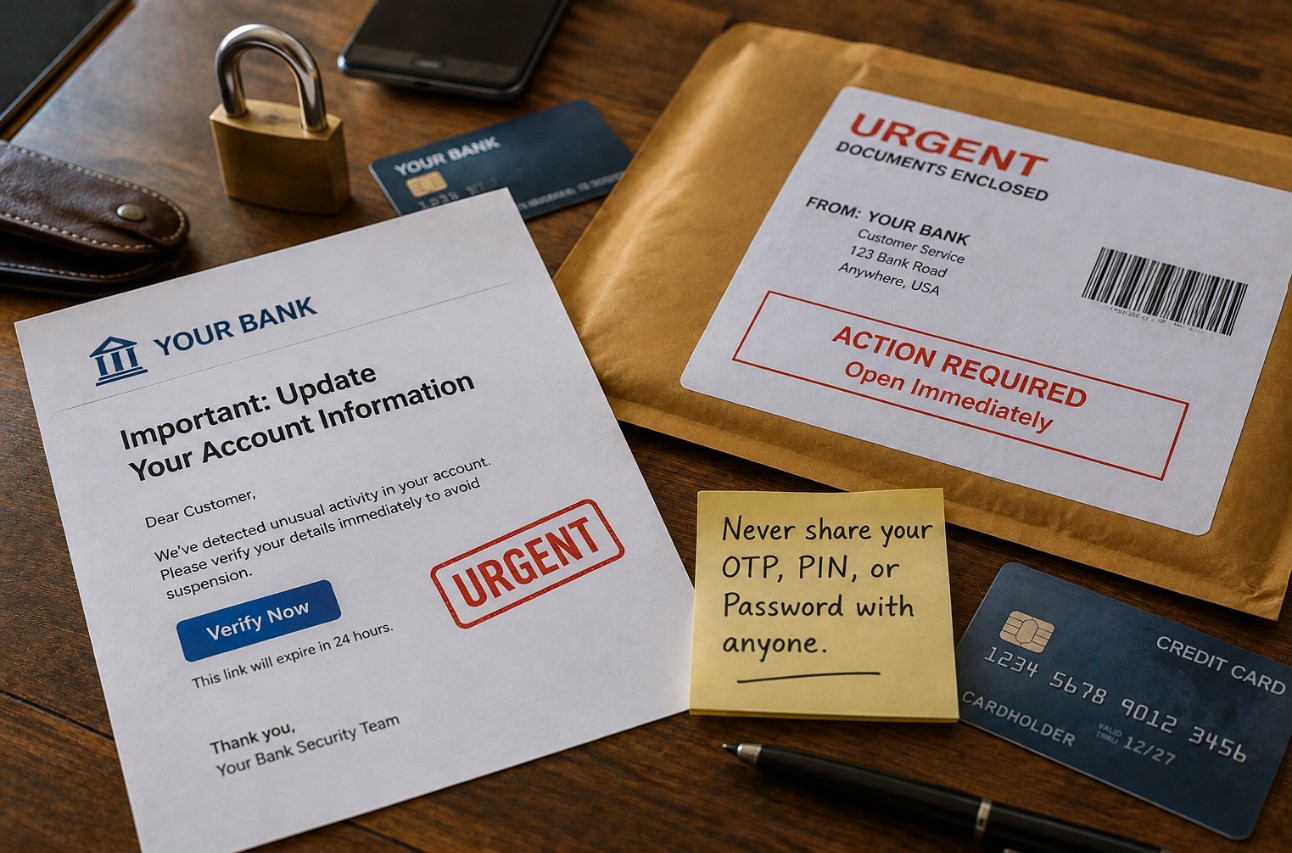
A stranger calls and says your bank account is under attack. They sound calm, they know your name and address, and your bank's real number is showing on caller ID. Within an hour, that call can end with you handing an envelope of cash or a box of gold bars to a stranger standing on your front porch. This is the bank scam courier scheme, and it is draining the life savings of older Americans at an alarming rate.
Between 2023 and May 2025, the FBI's Boston division alone documented 103 cases of a courier collecting cash or gold from victims, with losses totaling $26,024,691. Roughly 98 percent of those losses came from people over 60. That is one FBI field office covering four states. The national picture is far larger.
The short answer first: no bank and no government agency will ever ask you to move money, withdraw cash, buy gold, share a one time code, or hand valuables to anyone at your door. If someone asks for any of that, hang up. This guide explains exactly how the scheme works so you can recognize every step, and what to do if a courier is already on the way.
Key takeaways
- FBI Boston alone documented 103 cash or gold courier collections totaling more than $26 million between 2023 and May 2025, and about 98 percent of losses came from people over 60.
- No bank, the FTC, the Justice Department or any government agency will ever send someone to your door to collect cash, gold or valuables.
- Caller ID showing your bank's real number proves nothing. Numbers are easy to fake.
- A "code word" to check with the courier is part of the scam. Both the caller and the courier work for the same criminals.
- A caller keeping you on the phone for hours is not helping you. It is stopping you from calling anyone who could tell you it is a scam.
What is a bank scam courier?
A bank scam courier is a person sent by criminals to your home to pick up cash, gold, silver, jewelry or other valuables after you have been frightened by a phone call. The caller pretends to be your bank's fraud department, a government agency or law enforcement. They convince you that your money is in danger and must be "protected," then arrange for a courier to collect it.
Couriers are often young people recruited online with promises of easy delivery jobs, or members of organized fraud networks. Some drive rideshare style cars. Some wear lanyards or show fake badges. Some send packages by mail or overnight shipping instead. The money usually ends up overseas within days.
This scheme is the dangerous evolution of older phone scams. Asking victims to buy gift cards or wire money left a trail and triggered bank warnings. Sending a person to the door removes both problems.
How big is the problem?
| Source | What it found |
|---|---|
| FBI Boston, 2023 to May 2025 | 103 courier collections of cash or gold, losses of $26,024,691 |
| FBI Boston, 2023 to May 2025 | About 98 percent of losses came from victims over 60 |
| Federal case, Rhode Island | About 300 victims across at least 37 states, known losses over $5 million |
| Federal case, Missouri | One overseas group netted $9.3 million, with pickups in at least 10 states |
| Federal case, Texas | One courier sentenced to eight years in prison in a conspiracy that began in India |
Details come from the FBI Boston field office and federal prosecutors in Rhode Island, eastern Missouri and western Texas. These are only the cases that were reported and prosecuted. Many victims never report out of embarrassment.
How the call starts
It usually begins with a text about a flagged payment, or a call where your bank's real name and number appear on the screen. The caller already knows your name, your address and sometimes recent transactions. That accuracy is not evidence they work for your bank. Personal data is bought from breaches, and caller ID spoofing makes any number appear real.
The claim is almost always one of three:
- A large payment is pending. Someone is moving money out of your account and they need your help to stop it.
- Your account has been hacked. Criminals are inside your online banking right now, and possibly a bank employee is involved.
- Your Social Security number is linked to a crime. This version brings in fake government officials to raise the fear.
Some callers stay on the line for hours, even across several days. That is not service, it is containment. While you are on the phone you cannot call your real bank or talk to family.
The version that starts with your computer
The FBI describes a specific chain that has become very common. It is worth reading in full, because each handoff adds credibility.
- An alert appears on your computer telling you to call a helpdesk.
- The helpdesk "inspects" your machine and claims to find illegal purchases, sometimes alleging criminal material is on it.
- You are transferred to someone posing as your bank, who threatens criminal charges or says your accounts are compromised.
- You are transferred again, to someone posing as the FTC or Department of Justice, who says your funds must go into a "government escrow account."
By the time money is mentioned, three separate authorities have appeared to confirm the story. None of them exists. If a pop-up started your story, our guide on closing a fake virus warning shows how it begins, and our Microsoft tech support scam guide covers the call script.
The script, step by step
Step 1: Fear
Your money is under attack, or you are under investigation. You must act today.
Step 2: Secrecy
You are told the bank branch may be involved, so you must not tell tellers what is happening. Some victims are told family members could be suspects too. The goal is to cut you off from anyone who might help.
Step 3: The "protection" plan
The caller explains that your savings must be moved somewhere safe: a new account, a government escrow fund, or "secure storage." Because banks question large transfers, they suggest withdrawing cash or buying gold or silver from a dealer.
Step 4: Coaching
You are told exactly what to say at the bank. Common cover stories include a home renovation, a family gift or buying a car. Some victims are kept on speakerphone while they stand at the counter.
Step 5: The courier
A person arrives at your home to pick up the cash or gold, often with a code word to "verify" them. Sometimes you are told to ship it by overnight mail or leave it in a specific place.
Step 6: Repeat
Once a victim pays, the calls continue. There is always another account to protect, another fee or another step. Many losses grow over weeks until a family member or bank finally steps in.
The code word trick
This detail matters more than any other, because it is designed to defeat exactly the caution you would normally use.
To make the pickup feel official, scammers give the victim a code, password or serial number and tell them to check it with the courier before handing anything over. The FBI has flagged this specifically. It works because it feels like security. You are being asked to verify.
But the code came from the scammer, and the courier came from the scammer. The check proves only that both sides work for the same criminal operation. Real institutions do not send anyone to your home to collect money, with or without a password.
The one rule to remember: anyone who comes to your door to collect cash, gold or valuables on behalf of a bank or government agency is a criminal. There are no exceptions.
Documented courier cases
About 300 victims across at least 37 states. In a case prosecuted in Rhode Island, two defendants pleaded guilty after collecting cash and gold from victims who had been told a courier would move their funds to a secure government location. Known losses exceeded $5 million.
$9.3 million netted by one overseas group. Five people were sentenced in Missouri for acting as couriers and handlers. Pickups happened in Arizona, California, Florida, Tennessee, Texas, Wisconsin, North Carolina, Pennsylvania, Massachusetts and Ohio. One victim, an 82 year old woman in St. Louis, was first contacted by someone claiming to be from a computer software support team.
Eight years in prison for one courier. A man who collected cash and gold from elderly victims was sentenced in Texas in a conspiracy that originated in India. Victims were told by someone impersonating a United States Attorney that they were under investigation and needed to deposit cash or gold to resolve it.
The pattern across all of these is identical: fear, a fake official, and a person at the door.
Why gold, and why a courier
Both choices are deliberate.
Gold turns a bank balance into an object that can be carried away and sold with no transaction trail. Once it leaves your hands there is nothing to reverse, no bank to call and no chargeback.
The courier solves the scammer's hardest problem, which is getting money out of a bank. Banks train staff to question large cash withdrawals and wires from older customers. By telling victims to withdraw cash or buy gold and keep the reason secret, scammers sidestep those safeguards. The courier then collects the money in person, leaving no electronic trail.
Some schemes use precious metals dealers who do not know they are part of a scam. Victims are told to buy coins or bars and keep them at home until the courier arrives.
Why smart people fall for it
The caller knows real details. Your name, address, bank and recent purchases make the call feel genuine.
Caller ID looks right. Seeing your bank's real number is powerful, even though it can be faked in seconds.
Multiple "authorities" back the story. A tech support agent, a bank officer and a government official all saying the same thing feels like proof.
Fear of being blamed. When told your accounts are linked to crime, many people comply to clear their name.
Isolation. Long calls, secrecy instructions and warnings not to trust bank staff remove every outside check.
Victims include retired executives, nurses, teachers and engineers. If this happened to you, it is not a sign of weakness. It is a sign that professional criminals did exactly what they trained to do.
Who the couriers are, and the "delivery job" trap
Many couriers are not masterminds. Some are members of organized fraud rings who travel from city to city making pickups. Others are ordinary people recruited through online job ads for "delivery drivers," "personal assistants" or "logistics agents." They are told they are collecting documents or payments for a legitimate business, paid a small fee per pickup, and told to drop the package at a hotel, a shipping store or a parking lot.
That matters for two reasons. First, if you are approached with a job like this, walk away. Prosecutors have charged couriers who said they did not know what they were carrying. Second, it explains why couriers often look harmless: polite, young, well dressed, sometimes driving their own car. The friendly face at your door is part of the trap.
Couriers have also been told to pose as bank staff, government agents or "secure transport" workers. Some show printed letters with seals or badges. None of that is real. No genuine institution collects money at people's homes.
The mail and shipping version
Not every scheme sends a person. In a growing number of cases, victims are told to put cash inside a book, magazine or box and send it by overnight delivery to an address the caller gives them. Some are told to wrap the cash in foil or hide it between pages so it does not show up in scanners.
The same rules apply. No bank or agency asks you to mail cash. If you have already shipped a package, call the shipping company immediately with your tracking number and ask them to stop delivery, then call police. Shipping companies have intercepted packages when victims acted quickly.
Other variations ask victims to leave cash in a car, a mailbox or a bag outside the house, or to meet the courier in a store parking lot. Different method, same scam.
Red flags
- Anyone asks you to withdraw cash or buy gold or silver to "protect" your money.
- Someone will come to your home to collect money or valuables.
- You are given a code word to check with a courier.
- You are told not to tell bank staff or family what the money is for.
- You are coached on a cover story for the bank teller.
- The call lasts hours or the caller asks you to stay on the line.
- Several agencies appear in one story, such as tech support, your bank and the FTC.
- Your money must move to a "safe," "secure" or "escrow" account.
- You are threatened with arrest or told your Social Security number is linked to crime.
Your real bank vs a courier scam
| Your real bank | Courier scam |
|---|---|
| Freezes suspicious activity itself and asks you to call the number on your card | Asks you to move money yourself to protect it |
| Never sends staff to your home to collect cash | Sends a courier to your door |
| Wants you to talk to branch staff | Tells you not to trust tellers |
| Never asks you to buy gold or silver | Tells you to convert savings into metals |
| Never asks for a one time passcode | Asks you to read codes aloud |
| Encourages you to hang up and call back | Keeps you on the phone for hours |
How to protect yourself and your family
- Hang up on any call about bank fraud and call the number printed on your card or statement yourself, from a different phone if possible.
- Never move money to protect it. Your real bank protects your money without asking you to move it.
- Never hand cash, gold or valuables to anyone who comes to your door on behalf of a bank or agency.
- Agree on a family rule: any request to move a large sum gets a call to a trusted family member first.
- Add a trusted contact to your bank and investment accounts so staff can reach someone if they see unusual activity.
- Tell bank staff the truth. They are trained to recognize this scam and want to help.
- Check unknown numbers with our free robocall checker, and keep our free printable scam safety card by the phone.
What to do at the bank counter
If you are at the bank because a caller told you to withdraw money, stop and tell the teller exactly what the caller said. You will not be in trouble. Tellers see this scam every week and can confirm in minutes that your real accounts are safe.
If the caller is still on the phone or on speaker, hang up. If they told you to say the money is for a renovation or a gift, that instruction alone confirms it is a scam. Real fraud investigators never ask you to lie to your own bank.
Family members can help too. If a parent suddenly needs large amounts of cash, wants to buy gold, or seems to be on long secret phone calls, ask gently what is happening. A calm, judgment free conversation can stop a loss.
If a courier is on the way right now
- Do not hand over anything. Keep your door closed and locked.
- Hang up on the caller and do not answer if they call back.
- Call 911 or your local police and say a fraud courier is coming to your home. Police have arrested couriers at victims' doors.
- Call your bank on the number on your card to check your accounts and freeze any transfers.
- Call a family member or trusted friend to be with you.
Already handed over money? Do this now
- Call local police immediately. Give the time of the pickup, the courier's description, the car and any license plate details.
- Call your bank and report any withdrawals, wires or transfers.
- Report to the FBI at IC3.gov. Include phone numbers, names used, codes given and courier details.
- Report to the FTC at ReportFraud.ftc.gov. The FTC also explains how to avoid government impersonator scams.
- If a dealer sold you gold, contact them with the details. Dealers sometimes help investigators trace pickups.
- Change passwords if the scam involved your computer, and remove any remote access software.
- Watch for more calls. Do not engage. Block the numbers.
If you are 60 or older, the National Elder Fraud Hotline at 1-833-FRAUD-11 (1-833-372-8311) can help you report and plan next steps. Our guide to the first 48 hours after a scam and our fraud help resources page list more contacts.
The follow up scam
After a courier scam, many victims are contacted by people claiming to be FBI agents, lawyers or "asset recovery" firms who say they caught the courier and can return the money for a fee. This is a second scam. The FBI has warned that criminals impersonate FBI staff handling IC3 complaints, and that IC3 does not contact victims to recover funds. Read our guide to recovery scams that target past victims to learn the signs.
Remember: no real agency charges a fee to return stolen money, asks for gift cards or crypto, or sends someone to your home to collect payment.
Related reading: our guide to tech support scams that empty bank accounts and our gold bar scam warning.
Frequently asked questions
Will my bank ever send someone to my home to collect money?
No. No bank, government agency or law enforcement office sends couriers to collect cash, gold or valuables. Anyone who does is a criminal.
Why do scammers ask me to buy gold?
Gold can be carried away and sold with no electronic trail, and buying it avoids bank questions about large transfers. Once handed over, it cannot be recovered through your bank.
The caller ID showed my bank's real number. Is the call real?
Not necessarily. Caller ID can be faked easily. Hang up and call the number on the back of your card to check.
The courier knew the code word. Does that mean it is safe?
No. The code word came from the scammer. It only proves the caller and courier work together. Never hand over money to anyone at your door.
What should I do if a courier is coming to my house?
Do not open the door or hand anything over. Call 911 or local police, then call your bank using the number on your card.
Can I get money back after a courier scam?
It is difficult, but report it quickly to police, your bank, IC3.gov and ReportFraud.ftc.gov. Couriers have been caught when victims reported fast.
Who can help older adults targeted by this scam?
The National Elder Fraud Hotline at 1-833-372-8311 helps people 60 and older report fraud and find support.
How we researched this article
This guide is based on FBI public warnings, federal court records from the U.S. Attorney's Offices in Rhode Island, Missouri and Texas, FTC consumer guidance, and scam reports from our readers. Every statistic links to its original source. We do not accept payment from any company mentioned here. If you spot an error, please email [email protected] and we will review it under our fact checking policy.
This article is for general consumer education and is not legal or financial advice. If you have lost money, contact police, your bank, the FTC and the FBI.
Read next on this topic
 That Overpaid Check From a New Client Is a TrapRead guide →
 Is DarkComet Still a Threat in 2026? What US Users Should KnowRead guide →
 The "Easy Online Job" on Telegram That Ends With You Paying in CryptoRead guide →
 Is That Really Social Security Calling? How to Spot Impersonation Scam CallsRead guide →
 Toll-Free Scam Numbers Reported Most in 2026Read guide →
 Debt Relief Scam Call Numbers to Watch Out ForRead guide →
Share Your Experience
No one has commented yet. If this happened to you as well, say so below. Knowing that other people had the same call makes it far easier for the next person to trust their instincts.
Add Your Comment
Every comment is read by a person before it appears, so it will not show up straight away. Never post your phone number, address, or bank details here.