Toll-Free Scam Numbers Reported Most in 2026
 ·
Published
·
10 min read
·
Published
·
10 min read
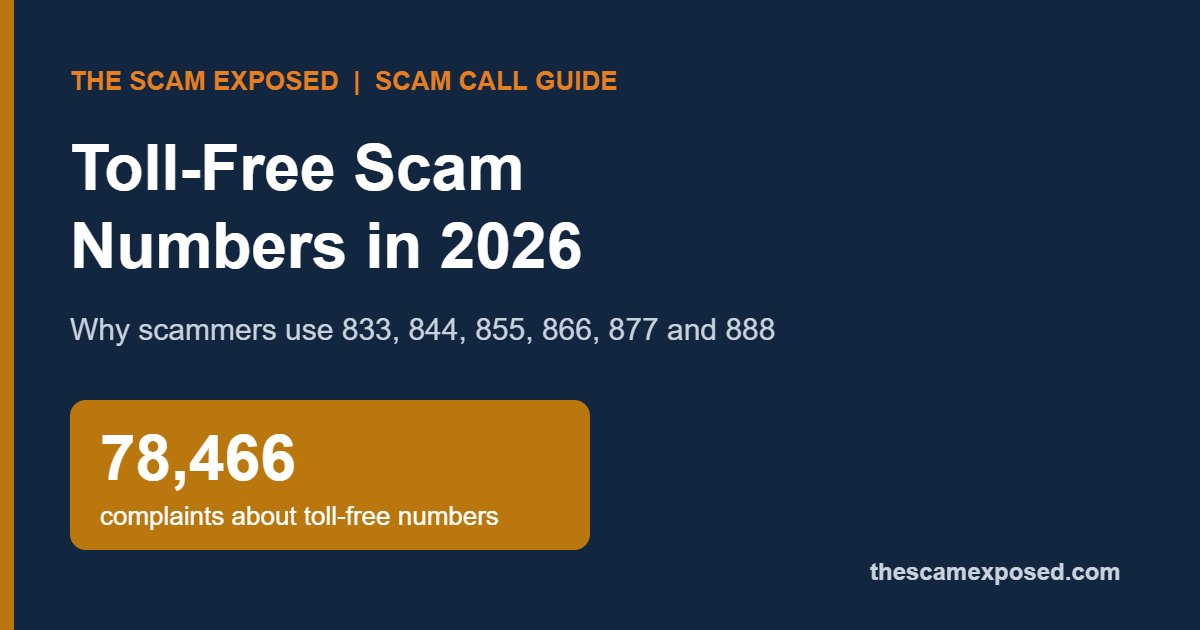
A number starting with 800, 833, 844, 855, 866, 877 or 888 looks like a real business line. That is exactly why scammers use them. In our data, toll-free numbers make up 12.8% of reported numbers but 16.5% of complaints, with 78,466 complaints about 33,793 toll-free numbers. The six toll-free prefixes above are the six most reported area codes in our entire database.
Why scammers like toll-free numbers
- They look official. Many people trust a toll-free caller ID more than a random local number.
- They are easy to get. Toll-free numbers can be set up through online phone services in minutes.
- They can be spoofed. Scammers can fake any caller ID, including a real company’s toll-free number.
Common scams from toll-free numbers
- Debt relief and credit card interest offers
- Fake bank, Amazon or tech support "fraud alert" calls
- Car warranty and home warranty offers
- Prize and sweepstakes calls that ask for a fee
How to stay safe
- Do not trust caller ID. A toll-free number proves nothing.
- If a caller says they are from your bank or a company you use, hang up and call the number printed on your card, bill or the company’s official website.
- Never give card numbers, bank logins, one-time codes or remote access to someone who called you.
- Report the call at DoNotCall.gov and ReportFraud.ftc.gov.
How toll-free numbers actually work
A toll-free number lets the person calling it avoid long distance charges, because the business that owns the number pays for the call. In the United States, the toll-free prefixes are 800, 833, 844, 855, 866, 877 and 888. For decades, these numbers were used almost only by established companies such as banks, airlines and retailers, which is why many people still see them as a sign of a real business.
Today, getting a toll-free number is cheap and fast. Internet phone services let almost anyone rent one in a few minutes, sometimes with no real check on who they are. On top of that, the number that shows on your screen does not have to be the number that actually made the call. Using caller ID spoofing, a scammer can display a toll-free number they do not own at all, including one that belongs to a real company.
What our data shows about toll-free scam calls
- They are overrepresented. Toll-free numbers are 12.8% of the phone numbers in our database but receive 16.5% of all complaints. On average, each toll-free number is reported more often than a regular number.
- 833 is the most reported prefix. It leads every area code in our data with 17,751 complaints, followed by 877, 888, 855, 866 and 844.
- Debt relief dominates. Most of the heavily reported toll-free numbers in the table below are tied to debt reduction calls, which matches the pattern we found across the whole dataset.
You can see how these prefixes compare with regular area codes in our list of area codes scam callers use most.
The most common toll-free scam scripts
"Your account has been locked"
A caller or recorded message says there is suspicious activity on your bank, Amazon or Apple account and gives you a toll-free number to call back. The person who answers asks you to "verify" your identity, read out a one-time code or install an app so they can "help". Real companies do not ask for one-time codes. Our guide to fake bank callers shows how far this scam can go.
Tech support callback numbers
A pop-up on your computer says you have a virus and tells you to call a toll-free number. The "technician" then asks for remote access and payment. We cover this in depth in fake Microsoft support calls and tech support scams that go after your bank account.
Debt relief and interest rate offers
These are the most reported toll-free calls in our data. A recorded voice offers to lower your credit card rate or settle your debt and asks you to press 1. See our full guide to debt relief scam call numbers.
Warranty and prize calls
Car warranty "final notices" and prize or sweepstakes calls often use toll-free numbers so they look like a real company. If you have to pay to receive a prize, it is not a prize.
Is a toll-free number ever safe?
Yes. Millions of real businesses use toll-free numbers every day. The problem is not the number itself but who is on the other end. A good rule is simple:
- If you called them using a number from your card, statement or the company’s official website, the number is generally safe.
- If they called you, or you got the number from a text, email, pop-up or voicemail, treat it with suspicion until you verify it yourself.
Scammers also buy search ads for fake support numbers, so even a number you found online can be fake. Our article on how to spot a Google search ad scam explains how this works.
How to check a toll-free number before you call back
- Look at the back of your card, your last bill or the company’s official app for the real customer service number.
- Type the company’s web address yourself instead of clicking a link or an ad.
- Search the number in our free phone number lookup to see whether others have reported it. Remember that no complaints does not mean safe.
- If the number in the message does not match the official one, do not call it.
How to reduce toll-free scam calls
- Turn on your carrier’s free spam filter. Our comparison of free scam call blocking on AT&T, Verizon and T-Mobile shows how.
- Set up the five phone settings that stop most scam calls, including silencing unknown callers.
- Never press a key to be removed from a list. Just hang up.
- Report unwanted calls at DoNotCall.gov so the data reaches regulators and phone companies.
Most reported toll-free scam numbers
These are the 30 toll-free numbers with the most complaints in our database. Click a number to see the details.
| Phone number | Complaints | Main topic | Last reported |
|---|---|---|---|
| (877) 957-2897 | 165 | Debt reduction | Not recorded |
| (833) 684-0936 | 111 | Debt reduction | Aug 2026 |
| (855) 357-2184 | 111 | Debt reduction | Not recorded |
| (844) 502-3058 | 104 | Debt reduction | Not recorded |
| (855) 580-2742 | 94 | Debt reduction | Aug 2026 |
| (855) 357-2212 | 91 | Debt reduction | Not recorded |
| (844) 502-3210 | 87 | Debt reduction | Aug 2026 |
| (877) 578-3941 | 83 | Debt reduction | Sep 2026 |
| (888) 577-8092 | 81 | Other | Aug 2026 |
| (877) 372-1095 | 80 | Debt reduction | Aug 2026 |
| (833) 684-5586 | 78 | Debt reduction | Not recorded |
| (855) 994-2101 | 78 | Debt reduction | Not recorded |
| (877) 578-3784 | 73 | Debt reduction | Not recorded |
| (888) 269-0263 | 73 | Debt reduction | Sep 2026 |
| (866) 666-1256 | 73 | Debt reduction | Not recorded |
| (855) 994-2094 | 72 | Debt reduction | Not recorded |
| (866) 771-5756 | 71 | Debt reduction | Not recorded |
| (877) 578-1859 | 71 | Debt reduction | Not recorded |
| (866) 386-2885 | 69 | Debt reduction | Not recorded |
| (833) 662-5741 | 69 | Debt reduction | Not recorded |
| (877) 961-0592 | 69 | Debt reduction | Not recorded |
| (866) 771-4496 | 68 | Debt reduction | Aug 2026 |
| (844) 502-3253 | 64 | Debt reduction | Sep 2026 |
| (866) 771-4573 | 63 | Debt reduction | Not recorded |
| (855) 994-2145 | 62 | Debt reduction | Sep 2026 |
| (877) 961-0019 | 61 | Debt reduction | Not recorded |
| (833) 652-4153 | 60 | Debt reduction | Not recorded |
| (888) 269-1624 | 60 | Debt reduction | Not recorded |
| (888) 912-0705 | 58 | Debt reduction | Not recorded |
| (855) 994-0124 | 57 | Debt reduction | Not recorded |
Complaint counts are unverified consumer reports, mostly from FTC Do Not Call data, as of September 2026. A number on this list may have been spoofed, meaning scammers faked it and the real owner may be innocent. We list only numbers with 10 or more complaints.
For the full data behind this page, see our scam call statistics case study, which looks at 475,404 complaints in detail.
Who gets targeted by toll-free scam calls
Anyone with a phone number can receive these calls, but some groups are hit harder than others.
- People carrying credit card debt are the main target of the interest rate and debt settlement calls that make up most toll-free complaints in our data.
- Older adults are more likely to answer calls from unknown numbers and to trust a caller who sounds like a business. Our guide to the costliest scams hitting older adults shows how large the losses can be.
- Small business owners often receive calls that pretend to be from payment processors, directory listings or utility companies, usually from toll-free numbers that look like real vendors.
- People who recently searched for customer support online may have called a fake support number from an ad and then get follow-up calls from the same group.
Helping a parent or grandparent with toll-free scam calls
If an older relative is getting a lot of these calls, a few small changes can make a big difference.
- Turn on call filtering together. Sit with them and set up the carrier filter and the silence unknown callers setting. It takes a few minutes and removes most robocalls.
- Save real numbers in their contacts. Add the bank, card company, pharmacy, doctor and family members, so real calls show a name and everything else can go to voicemail.
- Write down one rule. "If a company calls me, I hang up and call the number on my card." Put it next to the phone.
- Agree to talk before paying. Ask them to call you before they send money, buy gift cards or give anyone access to their computer.
For more ideas, our tech support scam guide for seniors and five scam texts to know in 2026 are good to share with family.
What people describe in toll-free scam complaints
When consumers file complaints about these numbers, the same details come up again and again:
- A recorded voice that does not say which company is calling
- Repeated calls from different toll-free numbers with the same message
- Being told to press 1 and then being connected to someone who will not give a company name or address
- Pressure to share card details within the same call
- The number going dead or being disconnected a few days later
That last point matches our wider finding that most scam numbers are used briefly and then abandoned, which you can read about in our scam call statistics case study.
Frequently asked questions
Why do scammers use 833 and 844 numbers so much?
The newer toll-free prefixes such as 833 and 844 have more numbers available, so they are easy and cheap to get through online phone services. In our data, 833 is the single most reported prefix.
Can a scammer show a real company’s toll-free number?
Yes. Caller ID spoofing lets scammers display almost any number, including a real bank’s customer service line. Always hang up and call the company back using a number you find yourself.
Should I call back a missed call from a toll-free number?
Only if you recognize the company and you use the number from your card, bill or the official website rather than the one that called you.
Does it cost me money to call a toll-free scam number?
Usually not, since the owner pays for toll-free calls. The danger is what the person on the line asks you to do, such as share codes, card numbers or install software.
Related reading
- Scam call statistics 2026 from 475,000 real complaints
- Debt relief scam call numbers to watch out for
- Impersonation scam calls pretending to be government or big companies
- Neighbor spoofing: why local numbers are calling you
- Scammed? What to do in the first 48 hours
Sources
About the author
Nitesh Kumar Gupta is the founder of The Scam Exposed and has more than 14 years of experience in digital marketing, search and online advertising. He tracks consumer complaint data to help families spot phone scams. This page is for general information only and is not legal or financial advice. It is updated as new complaint data comes in.
Share Your Experience
No one has commented yet. If this happened to you as well, say so below. Knowing that other people had the same call makes it far easier for the next person to trust their instincts.
Add Your Comment
Every comment is read by a person before it appears, so it will not show up straight away. Never post your phone number, address, or bank details here.