
Scam Call Statistics 2026 From 475,000 Real Complaints
 ·
Published
·
9 min read
·
Published
·
9 min read
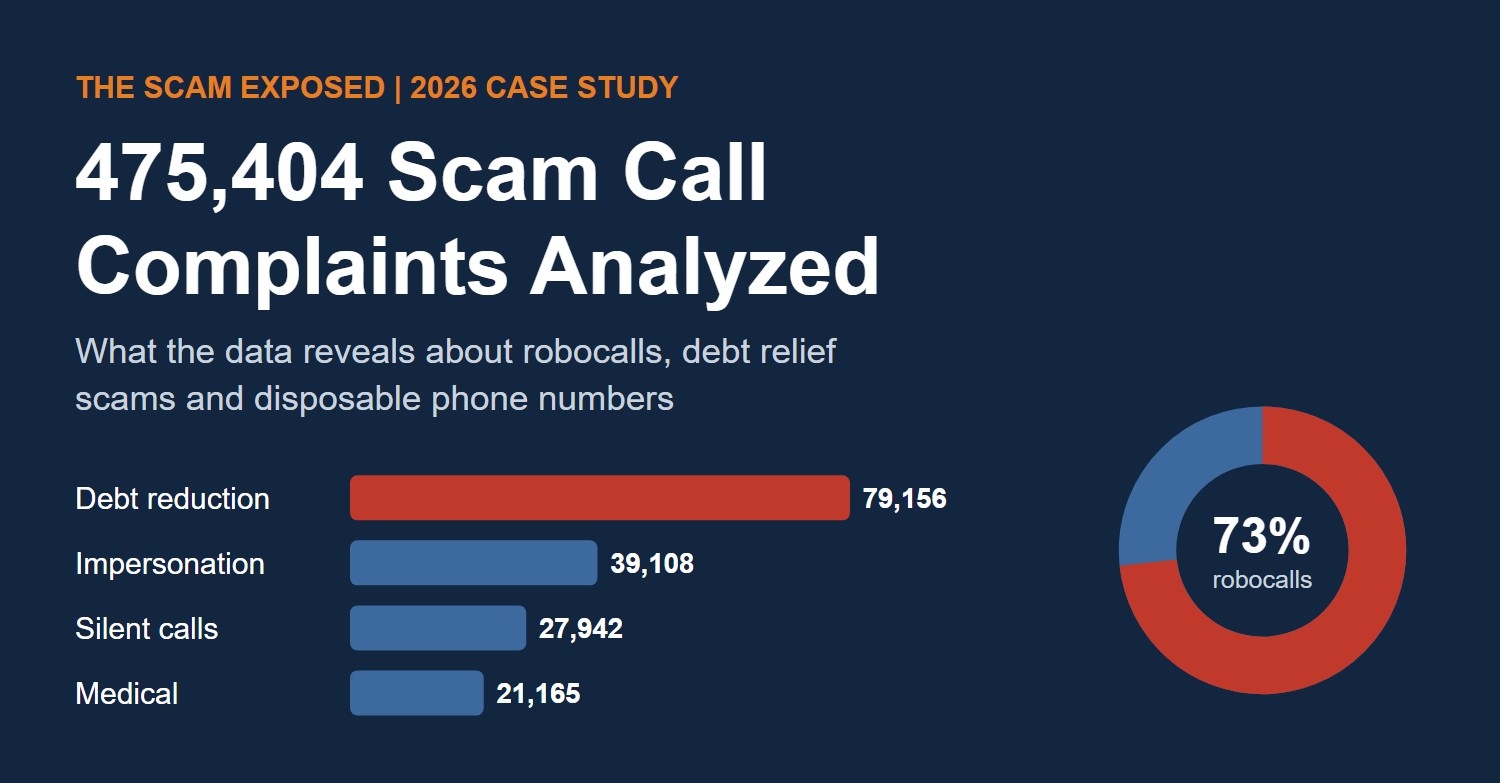
Most articles about scam calls repeat the same national totals. We wanted to look underneath them. So we took the consumer complaint records we collect at The Scam Exposed, which are mostly drawn from the Federal Trade Commission’s public Do Not Call complaint data, and asked a simple question: what does a typical scam call actually look like in 2026?
This case study covers 475,404 complaints about 263,003 different phone numbers. Almost all of them were filed between July and September 2026. Here is what the numbers show, what they do not show, and what you can do with this information.
Key findings
- Debt relief calls are the single biggest named problem. They make up 23.2% of all labeled complaints, more than twice the next topic.
- About 3 out of 4 unwanted calls are robocalls. 73.2% of complaints described a recorded message, not a live person.
- Scammers burn through numbers fast. 56% of reported numbers received only one complaint, and 99.7% of numbers with dated complaints were reported in a single calendar month.
- Toll-free numbers are heavily abused. Six toll-free prefixes (833, 877, 888, 855, 866, 844) are the six most reported area codes.
- No state is safe. Florida, California and Texas file the most complaints, which largely reflects their large populations.
Where this data comes from
The complaints in this study come from two places:
- FTC Do Not Call complaint data. The FTC publishes complaints that consumers file about unwanted calls. Each record includes the number that called, the date, the consumer’s state, the topic of the call and whether it was a recorded message.
- Reports submitted directly by our readers through our number lookup tool.
We grouped the records by phone number and counted complaints by topic, state, call type and area code. Not every complaint answers every question, so each chart below states the exact number of complaints it is based on.
1. Debt relief calls lead every named category
When consumers chose a topic for their complaint, debt reduction came up 79,156 times. That is 23.2% of the 341,530 complaints that carried a topic, and more than double the next named category, impersonation (11.5%).
These calls usually promise to lower your credit card interest, cut your balance or “settle” your loans. The FTC has warned for years that legitimate debt relief companies are not allowed to charge you before they actually settle or reduce a debt. A cold call offering to fix your debt, especially one that asks for card details upfront, is a strong warning sign.
Impersonation (callers pretending to be a government agency, bank or well-known company) and dropped or silent calls follow. Silent calls often come from automated systems checking which numbers are active, which is one reason you should not engage with them.
2. Most unwanted calls are robocalls
Of the 318,716 complaints that said how the call was delivered, 73.2% described a recorded message. Only 26.8% involved a live caller.
This matters for how you respond. A recorded message that asks you to “press 1” or “press 9 to be removed” is not a real opt-out. Pressing any key tells the system your number is active and answered by a person, which can lead to more calls.
3. Scammers use a number once, then move on
This was the most striking pattern in the data.
- 147,089 numbers (56%) received exactly one complaint.
- Another 102,247 (39%) received between two and four.
- Only 1,129 numbers (0.4%) reached ten or more complaints.
Timing tells the same story. Among numbers with dated complaints, 99.7% were reported in only one calendar month. Even among the heavily reported numbers (ten or more complaints), 71% never appeared outside a single month.
In practice, this means a scam operation can place calls from thousands of different numbers, often using caller ID spoofing, and abandon each one quickly. Blocking a single number helps very little. Carrier-level call filtering and settings that silence unknown callers are far more effective. It also means a number with no complaints is not proof that a call is safe.
4. The most reported numbers in our data
A small number of phone numbers attracted hundreds of complaints each. Nine of the top ten were tied to debt reduction calls.
| Phone number | Complaints | Main topic |
|---|---|---|
| (321) 395-8702 | 1,102 | Debt reduction |
| (369) 216-6437 | 429 | Debt reduction |
| (217) 834-9517 | 272 | Debt reduction |
| (830) 431-9830 | 249 | Debt reduction |
| (775) 438-1723 | 247 | Debt reduction |
| (833) 662-5845 | 233 | Debt reduction |
| (331) 888-1773 | 232 | Debt reduction |
| (866) 771-5090 | 225 | Debt reduction |
| (309) 301-1881 | 215 | Other |
| (217) 394-8983 | 197 | Debt reduction |
Complaint counts are unverified consumer reports. A high count means many people reported unwanted contact from the number. It does not by itself prove that the owner of the number committed fraud, because scammers often spoof numbers that belong to someone else.
5. Where the complaints come from
Florida (32,338), California (29,891) and Texas (27,060) filed the most complaints. Together they account for 28.8% of complaints with a state recorded. These are also the three most populous states, so raw counts partly reflect population rather than risk. The takeaway is that residents of every state receive these calls.
6. Toll-free numbers are the most abused
The six most reported area codes are all toll-free prefixes. Toll-free numbers account for 33,793 of the reported numbers (12.8%) but 78,466 complaints (16.5%), so each one tends to be reported more often.
Scammers like toll-free numbers because they look like a business line. A caller ID showing 833, 844 or 888 does not mean you are talking to a real company.
What this means for you
- Do not trust caller ID. Numbers are spoofed and replaced constantly. A familiar area code or a toll-free number proves nothing.
- Hang up on unexpected debt relief offers. If you need help with debt, contact a nonprofit credit counseling agency you find yourself.
- Never press a key on a robocall. Just hang up.
- Turn on call filtering. Use your carrier’s free scam blocking and your phone’s “silence unknown callers” setting rather than blocking numbers one by one.
- Never share card, bank or Social Security details with someone who called you, even if they already know some of your information.
- Report unwanted calls at DoNotCall.gov and fraud at ReportFraud.ftc.gov. Your report helps build data like this.
If you already shared payment details, contact your bank or card issuer right away. People aged 60 and over can also call the National Elder Fraud Hotline at 1-833-372-8311 for free help.
Limitations of this study
- These are complaints, not confirmed crimes. Complaints are self-reported and unverified. They show unwanted contact, not proven fraud.
- Spoofing affects the numbers. A reported number may belong to an innocent person or business whose number was faked.
- Our coverage grew over time. We imported much larger volumes of FTC complaint data from August 2026 onward, so complaint totals by month reflect when we collected data, not a real change in scam activity. For that reason this study does not report monthly trends.
- Not every field is filled in. Topic, state and call type are optional in many records, so each chart uses a different total, which we state in its caption.
- Complaint counts are not a measure of money lost. For national loss figures, see the FTC’s Consumer Sentinel reports.
Frequently asked questions
Is a phone number with many complaints definitely a scammer?
Not necessarily. Many complaints mean many people received unwanted calls from that number, but scammers often spoof real numbers. Treat it as a strong warning sign, not proof.
Why do I keep getting scam calls from different numbers?
Our data shows most numbers are used briefly and then abandoned. Scam operations rotate through large pools of numbers, so blocking one number rarely stops the calls. Carrier call filtering works better.
Are debt relief calls ever legitimate?
Legitimate companies generally do not cold call you with robocalls, and under FTC rules debt relief companies cannot charge fees before they settle or reduce your debt. If you want help, reach out to a nonprofit credit counselor yourself.
How can I check a number that called me?
You can search any number with our free phone number lookup. If it is not listed, that does not mean it is safe, because many scam numbers are only used for a short time.
Sources
- FTC: Do Not Call complaint data
- FTC: How to get out of debt
- FTC: Robocalls
- FCC: Caller ID spoofing
- U.S. Department of Justice: National Elder Fraud Hotline
Methodology note
Data snapshot taken on September 28, 2026 from The Scam Exposed complaint database. Complaints were grouped by the reported phone number. Percentages are calculated only from complaints that included the relevant field. Phone numbers in the table link to their individual lookup pages. You may reuse the charts and figures in this study with a link back to this page.
About the author
Nitesh Kumar Gupta is the founder of The Scam Exposed and has more than 14 years of experience in digital marketing, search and online advertising. He analyzes consumer complaint data to help families recognize and avoid phone and online scams. This article is for general information only and is not legal or financial advice.
This number is also searched as 2026475000.
What Do You Think?
No one has commented yet. If this happened to you as well, say so below. Knowing that other people had the same call makes it far easier for the next person to trust their instincts.
Add Your Comment
Every comment is read by a person before it appears, so it will not show up straight away. Never post your phone number, address, or bank details here.