Utility Shut-Off Scams: What to Do When a Caller Threatens Your Power
 ·
Published
·
20 min read
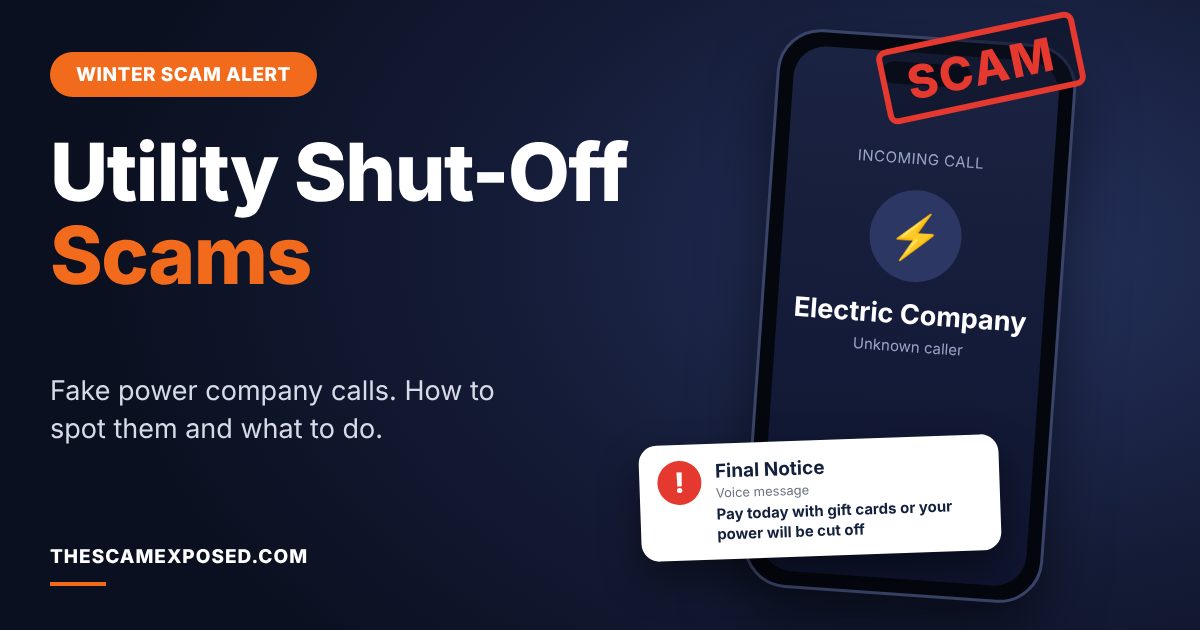
The phone rings and a calm voice says your power will be cut off today unless you pay right now. In cold weather that sounds frightening, and that is exactly why scammers use it. The fear is the whole trick.
I run The Scam Exposed. Most of the year we focus on scam calls and texts. But when heating bills arrive, readers start asking the same questions: "Someone called saying my electric bill is overdue. Is that real?" or "They told me to buy gift cards to keep my gas on. Is that normal?"
This guide explains how the utility shut-off scam works, the warning signs, what a real utility will and will not do, and exactly what to do if you already paid. Every fact here comes from an official source, mostly the Federal Trade Commission (FTC), the Federal Communications Commission (FCC) and the FBI Internet Crime Complaint Center (IC3). The sources are linked where they are used.
Key takeaways
- If you know your bill is already paid, a caller who says you owe money is a major red flag, even if the caller keeps pushing.
- According to the FTC, a real utility does not ask for banking information by email or phone, does not demand one specific payment method, and generally does not accept gift cards, cash reload cards or cryptocurrency.
- Caller ID can be faked, so the number on your screen does not prove who is calling. Hang up and call the number on your paper bill.
- The FBI IC3 received 47,794 tech and customer support impersonation complaints and 32,424 government impersonation complaints in 2025. The report has no separate utility category.
- If you paid, contact the company you paid through right away. The steps are different for gift cards, wire transfers, crypto, cards and payment apps.
- If you truly cannot pay a heating bill, call your utility and ask about help. The federal LIHEAP program can help with energy bills and does not charge a fee.
In this article (14)
- Why shut-off threats work so well in cold weather
- How the utility shut-off scam works
- What the official data shows, and what it does not
- Why the caller demands gift cards, wires and crypto
- Red flags checklist
- Real utility vs imposter caller
- Why caller ID cannot be trusted
- What to do when the call comes
- Already paid? Do this now
- If you really owe money or cannot pay your bill
- Helping a parent or grandparent
- Simple habits that prepare you before the call
- FAQ
- How we researched this article
Why shut-off threats work so well in cold weather
Most scams need to create pressure before they can take your money. A utility shut-off threat does that almost by itself. Heat, light and hot water are not optional, and nobody wants to find out at night that the power is gone.
Three things make this scam believable.
The bill is real. You do get a bill from a utility company every month. The caller does not need to invent a company. They only need to name yours and say you are behind.
The cost feels higher in winter. Heating bills are on many people's minds in cold months. A message that says "your balance is overdue" feels possible, even if you believe you paid.
The deadline leaves no time to think. Scammers say the service will be cut soon, so you will not stop to check. The FCC advises caution when you are pushed to give information immediately, which is why a rushed demand should make you more careful, not less.
None of this is new. The same pressure shows up in other scams too. If you want to see how the same script is used on tolls, read our guide on the unpaid toll text scam.
Got a call like this? Check the number for free against public FTC complaint records before you call back or reply.
Got a call or text like this? Check the number for free against public FTC complaint records before you call back or reply.
How the utility shut-off scam works
The details change from caller to caller, but the pattern is the same. Here is how it usually goes, based on the FTC's description of utility imposter scams.
- The contact. You get a phone call, or in some cases a message, from someone who says they work for your electric, gas or water company.
- The claim. They say you have a past-due balance. You may know you already paid, but the caller insists.
- The threat. They say your service will be disconnected unless you pay now.
- The payment demand. They ask for a payment method that is hard to trace or reverse, such as a gift card, a cash reload card, a wire transfer or cryptocurrency. Some ask for your bank account details by phone or email.
- The pressure. They push you to act quickly instead of stopping to check.
The FTC says it plainly: if you know your bill has been paid, the claim of a past-due balance is a big red flag. The agency also says legitimate companies do not demand one specific method of payment.
Why it works on careful people
This scam does not only catch people who are careless. It catches people who are responsible. If you pay your bills on time, a call about a missed payment makes you worry that you made a mistake. That worry is what the caller is counting on.
A caller who knows your name or address does not prove they work for your utility. Always check through a number you found yourself.
What the official data shows, and what it does not
I want to be careful with numbers here. I looked for official figures on utility imposter scams specifically. The FBI IC3 2025 Internet Crime Report does not use the word "utility" and does not list a utility imposter category. So I will not give you a utility-only statistic, because I could not find an official one to link.
What the report does show is how large phone-based impersonation fraud is overall. These are two categories that cover callers who pretend to be someone you might trust.
| Category | Complaints | Reported losses |
|---|---|---|
| Tech and customer support impersonation | 47,794 | $2,134,675,818 |
| Government impersonation | 32,424 | $797,943,193 |
| Combined call center fraud | More than 80,000 | More than $2.9 billion |
Source: FBI IC3 2025 Internet Crime Report. The report defines the first category as a subject posing as technical or customer support or service.
Older adults are hit hard in these categories. The same report shows that people 60 and older filed 8,628 government impersonation complaints in 2025, with reported losses of $413,206,251.
Two things to keep in mind. First, a utility imposter is not the same as a tech support or government imposter, and these totals do not measure utility scams. They show the scale of the wider problem. Second, these are only the people who reported. Many who lose money, or who hang up in time, never file a report.
Why the caller demands gift cards, wires and crypto
The payment method is usually the clearest clue. A real company has normal ways to take payment: your online account, a mailed check, a card, an autopay setup. A scammer needs money that cannot be pulled back.
The FTC lists the payment types scammers ask for, and says to be wary of requests for gift cards, cash reload cards, wire transfers or cryptocurrency. A July 2026 FTC consumer alert on its gift card scams page says reports to the FTC show that a demand to pay by bank transfer, wire, cryptocurrency, payment app or gift card is a scam.
There is another reason these methods matter. The FTC explains that federal law protects you from unauthorized credit and debit card use, but crypto payments lack the legal protections that credit and debit cards have, so recovery can be hard. That is one reason scammers steer you away from cards.
If a caller asks you to pay a utility bill with any of these methods, stop. You do not need to prove anything to the caller. You only need to hang up.
The one rule to remember: if someone who says they are from your utility tells you to pay with a gift card, cash reload card, wire transfer, crypto or a payment app, it is a scam. Hang up and check your account yourself.
Red flags checklist
- You already paid. If you know your bill is settled, a past-due claim is a major red flag.
- A demand for gift cards, reload cards, wires or crypto. A real utility does not need them.
- Pressure to pay right now. Threats of an immediate shut-off are meant to stop you from checking.
- Phone payment as the only option. A real utility does not require payment by phone as your only choice.
- One specific payment method. Legitimate companies do not insist on only one way to pay.
- A request for your bank details by phone or email. A real utility does not ask for these this way.
- A callback number the caller gives you. Use the number on your own bill instead.
- A caller who discourages you from hanging up and checking. A real utility will not mind if you call back on the number on your bill.
Real utility vs imposter caller
This table compares what the FTC says legitimate utility companies do with what an imposter does.
| What to check | Real utility | Imposter caller |
|---|---|---|
| Banking information | Does not ask for it by email or phone | Asks for account or card details on the call |
| Payment method | Does not demand one specific method | Insists on a single method |
| Phone payment | Does not require it as your only option | Says phone payment is the only way |
| Gift cards, reload cards, crypto | Generally does not accept them | Asks for them |
| Your own bill | Matches what your account and paper bill show | Claims a balance even though you paid |
| Calling back | Fine to hang up and call the number on your bill | Gives you a number to call instead |
Source: FTC, Empower yourself against utility scams. The FTC's published warning signs cover banking information, payment methods and past-due claims. The last column shows how an imposter would act in each case.
Why caller ID cannot be trusted
Many people feel safe when their phone shows the utility's name or a familiar number. That feeling is exactly what scammers want.
The FCC explains that caller ID spoofing is when a caller deliberately falsifies the information shown on your caller ID display to hide who they are. Scammers use it to make a call look local, or to pose as a company or agency you already trust.
The FCC also says you may not be able to tell right away that a call is spoofed. Its advice is simple:
- Do not answer calls from unknown numbers.
- If you answer and the call seems wrong, hang up right away.
- If a caller or recording tells you to press a button to stop calls, hang up. The FCC calls this a common scammer tactic.
- Do not answer questions, especially ones that can be answered with yes or no.
- Never share account numbers, Social Security numbers, passwords or other identifying details in response to an unexpected call.
- If someone says they represent a company, hang up and call the number on your account statement or the official website.
To learn why a call can seem to come from your own area code, read our guide on neighbor spoofing. To block more of these calls, see five phone settings that stop most scam calls and free scam call blocking from AT&T, Verizon and T-Mobile.
What to do when the call comes
The steps are the same whether you are sure it is a scam or only suspicious. You do not have to decide. You only have to check in a safe way.
- Hang up. You do not need to argue, explain or be polite. Ending the call is enough.
- Do not press any button the caller or recording tells you to press.
- Check your account yourself. Look at your paper bill or log in on the utility's website. If you need to talk to someone, call the number printed on your bill or listed on the company's official website. Never use a number the caller gave you.
- Do not share banking information on a call you did not start. The FTC says to share it only on calls you started, to a number you know is legitimate.
- Tell someone you trust. Scammers want you to act alone and fast. A short conversation with a family member or neighbor breaks the pressure.
- Report the call. Report it to the FTC at ReportFraud.ftc.gov and tell your real utility company.
If the call came as a text with a link, do not tap it. Our guide on common scam texts shows the patterns to look for, and you can forward scam texts to 7726 (SPAM) so your carrier can block the sender.
Already paid? Do this now
If you paid someone who may have been an imposter, act quickly. You are not the first person to be caught by a convincing call, and being fooled does not mean you were careless. The steps below follow the FTC's guidance on what to do if you were scammed. The right step depends on how you paid.
If you paid with a gift card
Contact the gift card issuer right away, using the number on the back of the card. Tell them a scammer tricked you into giving the card number and PIN, and ask for a refund. Keep the card and the receipt, since you may need them for your claim.
If you paid by wire transfer
Report the transfer to the wire transfer company immediately. Tell them a scammer tricked you into sending the money, and ask for a refund.
If you paid with cryptocurrency
Contact the exchange or ATM operator immediately, tell them the transaction was fraudulent, and ask them to reverse it and refund you. Then report it to the FTC. The FTC warns that crypto payments lack the protections that cards have, so recovery can be hard.
If you paid with a credit or debit card
Report it to the card issuer or bank immediately, using the number on the back of your card or your online account or app, and ask for a refund. Federal law protects you from unauthorized card use.
If you paid with a payment app
Report the payment to the app immediately and ask them to reverse the payment and refund you.
If you sent cash by mail
Contact the U.S. Postal Inspection Service at 1-877-876-2455 immediately. For cash sent through FedEx or UPS, contact that carrier as soon as possible.
Then protect your accounts and identity
- If you shared a login or password, create a new strong password, change it anywhere else you used it, and turn on two-factor authentication.
- If you gave a caller access to your phone or computer, update your security software, run a scan, change your passwords and turn on two-factor authentication.
- If you gave your Social Security number, report it at IdentityTheft.gov and follow the recovery plan it gives you.
Report it so others are warned
- File a report with the FTC at ReportFraud.ftc.gov.
- File a complaint with the FBI at ic3.gov, even if the amount was small.
- Tell your real utility company that someone used its name.
- If you are 60 or older, or helping someone who is, you can call the National Elder Fraud Hotline at 1-833-372-8311 for free help with reporting.
Our step by step help page walks through these actions in order, and you can report the number to us so other people see a warning.
Watch out for a second scam. After you report a loss, someone may contact you claiming they can get your money back for a fee, or claiming to be from the FTC. The FTC says it will never threaten you, tell you to move money to "protect" it, or tell you to withdraw cash or buy gold to hand over. Read why past scam victims are targeted again.
If you really owe money or cannot pay your bill
Some people get this call at a time when money really is tight. If your bill is genuinely behind, or you are afraid it will be, do not wait for a caller to bring it up.
- Call your utility yourself. Use the number on your paper bill or the official website. Ask what you owe and what payment options and help programs are available.
- Look into LIHEAP. The Low Income Home Energy Assistance Program is a federally funded program that helps families with home energy costs. According to the Administration for Children and Families, it can help with heating bills, preventing energy shutoffs and reconnecting service after one.
- Find your local office. The program points people to EnergyHelp.us and to the National Energy Assistance Referral hotline at 1-866-674-6327, weekdays from 9:00 am to 7:00 pm Eastern Time.
Fake help offers exist too. The program says LIHEAP does not provide direct grants to individuals and does not charge a fee. If someone offers you a LIHEAP grant, or asks you to pay for one, report it to the HHS Fraud Hotline at 1-800-447-8477.
Helping a parent or grandparent
Many adult children get a worried call from a parent that starts with "The power company says they will shut us off." These calls are stressful for everyone, but a calm plan helps.
Older adults are targeted often in phone impersonation. In the IC3 data above, people 60 and older filed 8,628 government impersonation complaints in 2025. The FBI report does not give a separate figure for utility scams, but the same trust-based tactics are used.
- Agree on one rule: nobody pays a utility with gift cards, a wire transfer, crypto or a payment app. Ever.
- Keep the real number handy. Write your utility's customer service number on the refrigerator or save it in the phone as "Electric company real number."
- Make hanging up normal. Tell them it is always fine to hang up and call back, and that no real company will be angry about it.
- Ask to be called first. A simple "call me before you pay anyone" rule stops most of these scams.
Our guide on the impersonation scam calls older adults report covers a related script, and the fake bank fraud alert that tells you to send money shows how the same pressure is used on bank customers.
Simple habits that prepare you before the call
- Save your utility's real number. Put the number from your paper bill in your phone contacts, so you can call it without searching.
- Know your account status. If your utility has an online account or app, check your balance now and then, so a false claim stands out.
- Set up bill reminders or alerts through your utility or bank, so you know what is due and when.
- Do not rely on caller ID. Treat any call about money as unverified until you call back on a number you found yourself.
- Use free call blocking. Ask your phone carrier about the free scam call tools it offers.
- Pay with a protected method. Cards and your utility's own payment portal give you more protection than gift cards, wires or crypto.
FAQ
Is a call saying my power will be shut off today real?
It can be hard to tell, so do not decide on the call. Hang up, then check your balance on your paper bill or your utility's website. Call only the number printed on your bill. If the caller demanded gift cards, a wire transfer, crypto or one specific payment method, it is almost certainly a scam.
Will a real utility ask me to pay with a gift card?
No. According to the FTC, legitimate utility companies generally do not accept gift cards, cash reload cards or cryptocurrency, and they do not demand one specific method of payment.
Can a real utility ask for my bank information by phone?
The FTC says a real utility does not ask for your banking information by email or phone. Share bank details only on a call you started, to a number you know is legitimate.
Why does the call show my utility's name on caller ID?
Caller ID can be faked. The FCC explains that spoofing means a caller deliberately falsifies the information shown on your display. A familiar name or number does not prove who is calling.
What should I do if I already paid with a gift card?
Contact the gift card issuer right away using the number on the back of the card. Tell them a scammer tricked you into giving the card number and PIN, and ask for a refund. Keep the card and the receipt.
Can I get my money back if I paid by wire or crypto?
Report it immediately to the wire transfer company or to the crypto exchange or ATM operator and ask for a refund. The FTC warns that crypto lacks the protections cards have, so recovery can be hard. Recovery is not guaranteed, but reporting still helps.
Where do I report a utility scam call?
Report it to the FTC at ReportFraud.ftc.gov and to the FBI at ic3.gov if you lost money. Also tell your real utility company that someone used its name.
Is there real help if I cannot pay my heating bill?
Yes. Call your utility directly to ask about payment options and help programs. The federal LIHEAP program helps families with home energy costs. You can find where to apply through EnergyHelp.us or the National Energy Assistance Referral hotline at 1-866-674-6327.
Does the FBI report show how many utility scams there are?
No. The FBI IC3 2025 Internet Crime Report does not list a utility imposter category. It does report 47,794 tech and customer support impersonation complaints and 32,424 government impersonation complaints for 2025, which show the scale of phone impersonation fraud overall.
How we researched this article
This guide is based on the FTC consumer advice article on utility scams (page last modified September 2025), the FTC guidance on what to do if you were scammed (page modified August 2026), the FTC gift card scams page, the FCC guide on spoofing and caller ID (page last reviewed in 2020), the Administration for Children and Families page on LIHEAP, and the FBI Internet Crime Complaint Center 2025 Internet Crime Report. Figures are quoted as published by those agencies and represent reported complaints only. We did not find an official utility-specific complaint figure, so we do not give one. See our methodology and editorial policy for how we review sources. The Scam Exposed is an independent educational platform. We are not a government agency, law enforcement body, or legal advisors. Consult official channels for legal recourse.
Read next on this topic
 Charity Scams This Giving Season: How to Check a Charity Before You GiveRead guide →
 Neighbor Spoofing: Why Scam Calls Use Your Own Area CodeRead guide →
 US Scam Call Statistics 2026: Real Numbers With SourcesRead guide →
 Zelle Scam: The Fake Bank Fraud Alert That Tells You to Send MoneyRead guide →
 The FTC Is Not Calling to Shut Off Your Phone NumberRead guide →
 That Overpaid Check From a New Client Is a TrapRead guide →
Share Your Experience
No one has commented yet. If this happened to you as well, say so below. Knowing that other people had the same call makes it far easier for the next person to trust their instincts.
Add Your Comment
Every comment is read by a person before it appears, so it will not show up straight away. Never post your phone number, address, or bank details here.