
Charity Scams This Giving Season: How to Check a Charity Before You Give
 ·
Published
·
20 min read
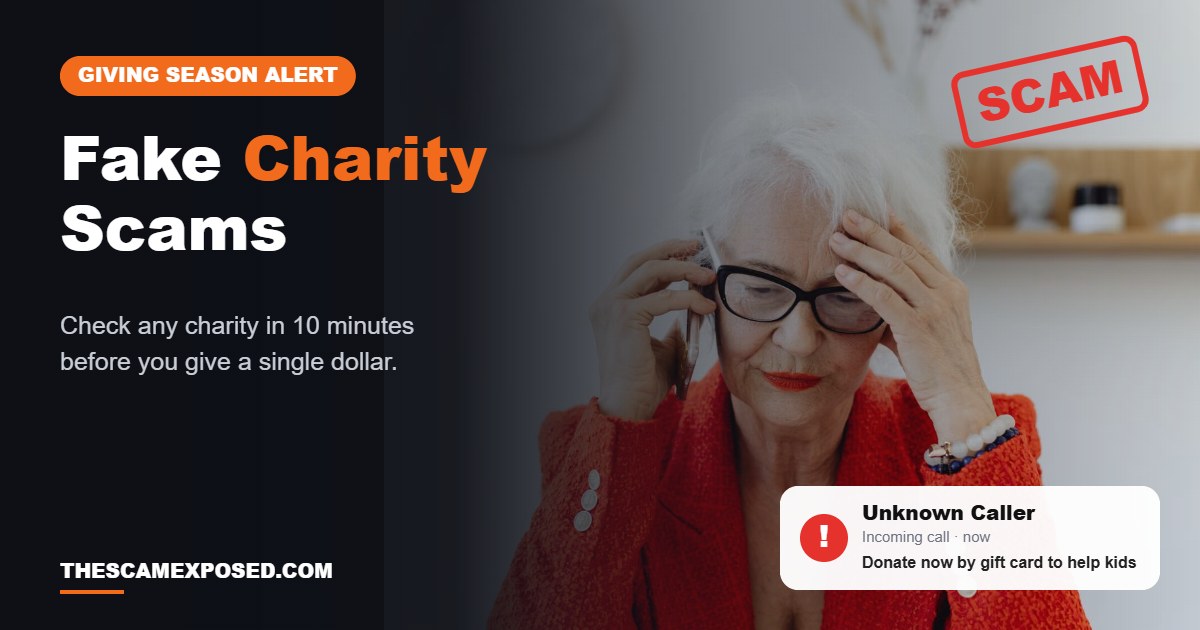
Giving Tuesday, the days before Christmas and the last week of December are some of the busiest times of the year for giving. They are also when fake charities work the hardest, because a generous person in a hurry is exactly who a scammer wants to reach.
I started The Scam Exposed to help people check phone numbers, texts and websites before they trust them. Charity scams are one of the most painful types we cover, because the victim is someone who was trying to do something kind. The loss is not only money. It is the feeling that you cannot trust a good cause again.
The good news is that checking a charity is quick and free. This guide explains how fake charities work, the rules real fundraisers must follow, the exact tools the Federal Trade Commission (FTC) recommends, and what to do if you already gave to a scam.
Key takeaways
- The FBI received 662 charity fraud complaints in 2025, with reported losses of $7,907,609.
- Many charity scams are never reported, because victims often do not realize they gave to a fake group.
- The FTC says requests for crypto, wire transfers, payment apps or gift cards are signs of a scam. Credit card or check is safer.
- Fundraisers can only call between 8 a.m. and 9 p.m. and must tell you the charity's name and purpose.
- You can check a charity for free with the IRS Tax Exempt Organization Search, your state charity regulator, and rating groups like BBB Wise Giving Alliance and Charity Watch.
- Never let anyone rush you. A real charity will still take your donation tomorrow.
In this article (15)
- Why charity scams peak at the end of the year
- What the FBI numbers show
- The most common charity scams
- Fundraising calls: the rules real fundraisers must follow
- Social media and crowdfunding appeals
- How to check a charity in 10 minutes
- What to say when a fundraiser calls
- Year end giving and tax deductions
- A real case: four sham cancer charities
- Red flags checklist
- Real charity vs scam charity
- How to give safely this season
- Already donated to a scam? Do this now
- FAQ
- How we researched this article
Why charity scams peak at the end of the year
The end of the year combines three things scammers love.
People are in a giving mood. The holidays are built around generosity. Giving Tuesday, which falls on the Tuesday after Thanksgiving, is promoted as a national day of giving. That means a lot of donation requests arrive at once, and it is hard to tell the real ones from the fake ones.
There is a deadline. Many people want to give before December 31. Scammers use that pressure with messages like "give before midnight to double your impact."
Emotions are high. Holiday appeals often focus on sick children, veterans, hungry families or disaster victims. These are real needs, and real charities talk about them too. Scammers copy the same stories because they know they work.
The FTC put it simply in its 2024 Giving Tuesday alert: "Scammers are pros at tricking people into donating."
Got a call or text like this? Check the number for free against public FTC complaint records before you call back or reply.
What the FBI numbers show
The FBI Internet Crime Complaint Center (IC3) tracks charity fraud as its own category. Here is what the FBI IC3 2025 Internet Crime Report shows:
| Group | Complaints | Reported losses |
|---|---|---|
| All ages | 662 | $7,907,609 |
| People 60 and older | 126 | $3,474,668 |
Source: FBI IC3 2025 Internet Crime Report, crime type tables for all complainants and for complainants 60 and older.
Two things stand out. First, people 60 and older filed less than a fifth of the complaints, but reported close to 44 percent of the losses. When older donors are hit, they tend to lose more. Second, 662 complaints is a small number compared to other scam types. That does not mean charity fraud is rare. It means it is under reported. Most people who give $25 or $50 to a fake charity never find out it was fake, so they never file a report.
Losses can also be spread over time. A donor who agrees to a "small monthly gift" on the phone may not notice the charge for months, and may never connect it to a fake charity at all.
The IC3 numbers also only cover complaints filed with the FBI. Many charity scams are reported to the FTC or to state charity regulators instead, or not reported at all.
The most common charity scams
1. Look alike charity names
Scammers often pick names that sound almost exactly like well known charities. One extra word or a small change, like "Fund" instead of "Foundation," is enough to fool someone who is not looking closely. The FTC advises writing down the exact name of any charity that asks you for money and researching it before you give, because scammers use names that resemble real charities.
2. Fake phone fundraisers
A caller says they are raising money for police officers, firefighters, veterans or children with cancer. They are friendly, they know the right words, and they ask for a donation "today." Some claim you donated last year and they are just calling to renew. The FTC says that if someone claims you already pledged or donated, verify it yourself before paying.
3. "You won a prize" donations
Some fake charities link a donation to a sweepstakes or contest. "Give $50 and you are entered to win $10,000." Or worse, "You already won, just make a donation to claim it." The FTC warns to be skeptical of anyone who guarantees a prize or contest win in exchange for a donation.
4. Disaster and tragedy appeals
Within hours of a hurricane, flood, fire or shooting, fake fundraisers appear online. They use real photos from the news and a real sense of urgency. The FTC issues warnings like this after major disasters, such as its 2025 alert about the Texas floods.
5. Text and email donation links
A text arrives: "Help a family in need this Christmas. Donate now: [link]." The link goes to a page that looks like a real charity but is built to steal your card details. The FTC's advice is clear: do not use links or contact details in unexpected texts. Go to the charity's website yourself.
6. Appeals that use police, firefighters and veterans
Causes that people respect deeply are popular with fake fundraisers. A caller may say they are collecting for a local police association, injured firefighters or homeless veterans. Some of these calls are from real groups. Others are not, and some come from groups with real sounding names that send very little to the cause.
The safest approach is the same as for any other charity: get the exact name, do not give on the call, and check it yourself. If you want to support local police or firefighters, you can also contact your local department directly and ask which groups they actually work with. They will usually be glad you asked.
7. Sham charities that are technically registered
Not every fake charity is a stranger with a fake name. Some are real organizations on paper that spend almost nothing on the cause. They raise millions, pay fundraisers and insiders, and send only a tiny share to the people they claim to help. These are harder to spot, which is why checking how a charity spends its money matters. The real case below is an example.
Fundraising calls: the rules real fundraisers must follow
Charity calls are allowed even if your number is on the National Do Not Call Registry. But fundraisers still have to follow rules. According to the FTC's guide to giving to charity, fundraisers:
- Can only call between 8 a.m. and 9 p.m.
- Must tell you the charity's name and the purpose of the call.
- Cannot lie about important facts, such as how your donation will be used.
- Cannot use robocalls or prerecorded messages unless you are already a member or past donor, and even then they must offer you a way to opt out.
- Must show truthful caller ID with a number you can call to ask to be put on the charity's do not call list.
If a caller breaks these rules, the FTC says to treat that as a sign of dishonesty and find another way to give.
Questions to ask any fundraising caller
- What is the exact name of the charity, its website and its mailing address?
- Are you calling for a charity, or for a Political Action Committee (PAC)? The FTC notes donations to PACs are not tax deductible.
- How much of my donation goes to the program I want to help?
- Is my donation tax deductible?
Then hang up and check the answers yourself. The FTC suggests calling the charity directly to compare what it says with what the caller told you.
Also remember: caller ID can be faked. A call that shows a charity's name, or even a local number, proves nothing. Read our guide on why scam calls use your own area code. If a fundraiser calls from a number you do not know, you can check the number for free before you call back.
Social media and crowdfunding appeals
Many holiday fundraisers now happen on social media and crowdfunding sites. Some are real and deeply important. Others are fake, or are run by people with no link to the cause they describe.
The FTC gives specific advice here:
- Check where the link goes. On a crowdfunding page, the money goes to the organizer, not directly to the cause. Make sure you trust the organizer to pass it on.
- Know the person who shared it. The FTC's 2024 alert says to make sure the friend who shared a fundraiser actually knows the person or group raising money.
- Donations to individuals are not tax deductible. If a tax deduction matters to you, give to a registered charity.
- Watch for look alike websites. A website address with one letter changed can lead to a page built to steal your information or install harmful software.
Social media ads for charities need the same care as shopping ads. Our guide on how to check social media ads explains what to look for.
How to check a charity in 10 minutes
You do not need special skills to check a charity. These are the free steps the FTC recommends, in the order I use them.
Step 1: Search the name with warning words
Search the charity's exact name plus words like "complaint," "review," "rating," "fraud" or "scam." If other people have had problems, you will often find them in the first page of results.
Step 2: Check if it is a real tax exempt charity
The IRS has a free Tax Exempt Organization Search tool on irs.gov. It shows whether an organization is recognized as tax exempt and whether donations to it are tax deductible. If you cannot find the charity there, be careful.
Step 3: Check your state charity regulator
Many states require charities and paid fundraisers to register. The FTC points to nasconet.org, the National Association of State Charity Officials, where you can find your state's charity regulator and check registration.
Step 4: Look up ratings
The FTC names several groups that rate or report on charities: the BBB Wise Giving Alliance, Charity Navigator, Charity Watch and Candid (formerly GuideStar). These can show how a charity spends its money and whether it meets basic standards.
Step 5: Read the charity's own website
A real charity explains its programs and how it uses donations. The FTC says: "If you can't find detailed information about a charity's mission and programs, be suspicious." Also look at how much the charity spends in cash on its programs, not only the value of donated goods it claims to give away. The FTC warns that some charities inflate the value of donated goods to look more successful.
If a charity passes all five steps, you can give with much more confidence. If it fails even one, it is fine to choose another charity doing similar work.
What to say when a fundraiser calls: a simple script
Many people give to phone fundraisers because saying no feels rude. You do not need to argue or explain. Here is a short script you can keep by the phone, or share with an older relative.
Caller: "Hi, I'm calling for the Example Children's Holiday Fund. Can we count on your gift of $50 today?"
You: "Thank you for calling. I don't give over the phone. Can you tell me the exact name of your charity, your website and your mailing address?"
Caller: "We really need help today. Can I take your card number now?"
You: "No thank you. If I decide to give, I'll go to your website myself. Please put me on your do not call list. Goodbye."
That is it. A real fundraiser will give you the details and accept your answer. A scammer will push harder, change the story, or hang up. Either way, you have lost nothing. If you want to give to that cause, you can check the charity using the steps above and donate directly.
The name in this example is made up. It shows how real a fake name can sound, which is exactly why writing it down and checking it matters.
Year end giving and tax deductions
Many people give in late December because they want a tax deduction for that year. Scammers know this, and some use "tax deductible" as a selling point even when it is not true.
A few points from the FTC's guidance are worth knowing:
- Check deductibility yourself. The FTC recommends the IRS Tax Exempt Organization Search to confirm a charity is tax exempt and that your donation is deductible. A caller saying "it's tax deductible" is not proof.
- Political groups are different. Donations to a Political Action Committee (PAC) are not tax deductible, even when the call sounds like a charity appeal. Ask directly who the caller represents.
- Gifts to individuals are not deductible. This includes most personal crowdfunding campaigns, even for very real needs.
- Keep your records. The FTC says to keep records of all donations, especially if you plan to claim them on your taxes.
For questions about your own tax situation, talk to a tax professional or check irs.gov. This article is general information, not tax advice.
Giving Tuesday and "matching gift" claims
Real charities often announce matching gifts on Giving Tuesday, where a sponsor doubles donations up to a limit. But scammers copy the same wording because it creates urgency: "Your gift will be tripled, but only for the next hour."
A real matching offer will be described on the charity's own website, often with the sponsor's name. If you only see the claim in a text, call or social media message, check the charity's website before you act on it.
A real case: four sham cancer charities
In May 2015, the FTC and law enforcement partners from all 50 states and the District of Columbia took action against four charities that claimed to help cancer patients.
According to the FTC press release, the four groups were Cancer Fund of America, Cancer Support Services, Children's Cancer Fund of America and The Breast Cancer Society. Together, regulators said, they took in more than $187 million from donors.
Here is how the case was described:
- How they asked for money: telemarketing calls, direct mail, websites, and materials in the Combined Federal Campaign, which raises money from federal employees.
- What they promised: pain medication, rides to chemotherapy and hospice care for cancer patients.
- Where the money went, according to the complaint: cars, trips, luxury cruises, college tuition, gym memberships, jet ski outings, sports and concert tickets, and dating site memberships.
- Fundraiser share: the FTC said professional fundraisers often received 85 percent or more of every donation.
- Inflated numbers: the groups reported more than $223 million in donated goods they claimed to distribute, but the complaint alleged they were only passing those goods through.
Three of the individuals agreed to settle, and under the proposed orders two of the charities were to be dissolved. Litigation continued against the others. The donations covered by the case were made between 2008 and 2012.
This case matters for holiday giving because these were not anonymous strangers. They were registered organizations with real sounding names, real phone campaigns and real paperwork. Donors were not careless. They were trusting. That is why the checks in the section above, especially looking at how a charity actually spends its money, are worth the few minutes they take.
Red flags checklist
- Pressure to give right now. The FTC says scammers rush you so you cannot research them.
- Payment by crypto, wire, payment app or gift card. The FTC says these requests are likely scams.
- A name that is almost, but not exactly, a famous charity. Write it down and check it.
- A claim that you already pledged or gave. Check your own records first.
- A prize or contest tied to your donation. Real charities do not guarantee winnings.
- Emotional stories with no details. No clear programs, no address, no reports.
- A link in an unexpected text or email. Go to the charity's site yourself.
- A caller who will not answer basic questions. Such as how much goes to the cause.
- Calls before 8 a.m. or after 9 p.m. Real fundraisers must follow calling hours.
The one rule to remember: a real charity will still accept your donation tomorrow. Anyone who says you must give right now, by gift card, wire or crypto, is not a charity you should trust.
Real charity vs scam charity
| What to check | Real charity | Scam charity |
|---|---|---|
| Payment | Credit card or check | Gift cards, wire transfer, crypto or payment app |
| Timing | Happy for you to research first | Pushes you to give immediately |
| Name | Exact, easy to find on IRS and state lists | Sounds like a famous charity, but slightly different |
| Programs | Clear details on what it does and where money goes | Vague emotional stories, few specifics |
| Phone calls | Follows calling hours, gives name and purpose | Calls at odd hours, avoids questions |
| Past donations | Has your real records | Claims you pledged when you did not |
| Prizes | No prize tied to giving | "Donate and win" or "donate to claim your prize" |
How to give safely this season
- Decide where you want to give before the season starts. Pick your charities in advance, then say "no thank you" to surprise requests.
- Give directly. Go to the charity's own website by typing it yourself, or mail a check to the address you verified.
- Pay by credit card or check. The FTC says this is safer than crypto, wire, payment apps or gift cards.
- Check the payment page. The FTC says to make sure it uses https, but remember that https alone does not prove a charity is real.
- Watch for recurring donations. After you give, check your statement to make sure you were charged the right amount, and that you did not sign up for monthly giving by mistake.
- Keep records. Save receipts and confirmation emails, especially if you plan to claim a tax deduction.
- Do not trust caller ID. If a call says it is from a charity, hang up and contact the charity yourself.
- Talk with older relatives. Share these steps with parents and grandparents, who often get many fundraising calls and letters in December. Our free printable scam safety card is a simple way to start.
Already donated to a scam? Do this now
- Contact your bank or card company right away. Use the number on the back of your card. Tell them the donation was fraud and ask them to stop or reverse it.
- If you paid by gift card, call the gift card company using the number on the card or its official website. Ask if the funds can be frozen, and keep the card and receipt.
- If you paid through a payment app, report the transaction inside the app and contact your bank.
- Report to the FTC at ReportFraud.ftc.gov. The FTC asks you to include the fundraiser's name, the charity's name, phone number, website and address, and anything else they told you.
- Report to your state charity regulator. Find yours through nasconet.org.
- Report to the FBI at ic3.gov if the scam happened online or by phone.
- If you are 60 or older, or helping someone who is, call the National Elder Fraud Hotline at 1-833-372-8311.
- If you shared card details on a fake donation page, ask your bank for a new card number.
For a full step by step plan, see our help page for scam victims. You can also report the fake charity or number to us so other readers get warned.
Watch out for a second scam. People who lost money to a fake charity are sometimes contacted again by someone offering to "recover" the donation for a fee. They may claim to work with the FTC, the FBI or a law firm. Government agencies do not charge you to get your money back. Read more about recovery scams that target past victims.
FAQ
How common are charity scams?
The FBI IC3 received 662 charity fraud complaints in 2025, with reported losses of $7,907,609. The real number is likely higher, because many people who give to a fake charity never realize it and never report it.
How can I check if a charity is real?
Search the charity's name with words like "scam" or "complaint," check the IRS Tax Exempt Organization Search, confirm registration with your state charity regulator through nasconet.org, and look up ratings from groups like BBB Wise Giving Alliance, Charity Navigator, Charity Watch or Candid.
Can charities call me if I am on the Do Not Call Registry?
Yes. Charity calls are allowed even if your number is on the National Do Not Call Registry. To stop them, ask the charity to put you on its own do not call list.
What hours can fundraisers call?
According to the FTC, fundraisers can only call between 8 a.m. and 9 p.m. They must tell you the charity's name and the purpose of the call.
What is the safest way to donate?
The FTC says donating by credit card or check is safer. Be very careful if a group only accepts cryptocurrency, wire transfers, payment apps or gift cards.
Are crowdfunding donations safe?
Some are, but the money goes to the organizer, not directly to the cause. Make sure you know and trust the organizer. Donations to individuals are not tax deductible.
A caller says I donated last year. Should I pay again?
Not until you check. The FTC warns that scammers sometimes claim you already pledged or donated. Look at your own records and contact the charity directly before giving.
Where do I report a fake charity?
Report it to the FTC at ReportFraud.ftc.gov and to your state charity regulator, which you can find at nasconet.org. If it happened online or by phone, you can also report it to the FBI at ic3.gov.
How we researched this article
This guide is based on the FBI Internet Crime Complaint Center 2025 Internet Crime Report, the Federal Trade Commission's guide to giving to charity and its consumer alerts on charity scams, and the FTC's May 2015 press release on the four sham cancer charities case. Figures are quoted as published by those agencies and represent reported complaints only. See our methodology and editorial policy for how we review sources. The Scam Exposed is an independent educational platform. We are not a government agency, law enforcement body, or legal advisors. Consult official channels for legal recourse.
Read next on this topic
 Neighbor Spoofing: Why Scam Calls Use Your Own Area CodeRead guide →
 US Scam Call Statistics 2026: Real Numbers With SourcesRead guide →
 Zelle Scam: The Fake Bank Fraud Alert That Tells You to Send MoneyRead guide →
 The FTC Is Not Calling to Shut Off Your Phone NumberRead guide →
 That Overpaid Check From a New Client Is a TrapRead guide →
 Is DarkComet Still a Threat in 2026? What US Users Should KnowRead guide →
Share Your Experience
No one has commented yet. If this happened to you as well, say so below. Knowing that other people had the same call makes it far easier for the next person to trust their instincts.
Add Your Comment
Every comment is read by a person before it appears, so it will not show up straight away. Never post your phone number, address, or bank details here.