
US Scam Call Statistics 2026: Real Numbers With Sources
 ·
Published
·
5 min read
This page collects the key numbers on scam calls and phone fraud in the United States in one place. Every statistic is written to stand on its own, with its source and the period it covers right next to it.
In this article (10)
- How much money do Americans lose to scams?
- How much do older adults lose to scams?
- How much is lost to imposter scams?
- What share of scam calls are robocalls?
- What are the most reported scam call topics?
- How long do scammers use one phone number?
- Which area codes do scam callers use most?
- Which states report the most scam calls?
- How much is lost to text message scams?
- How we researched this page
Some numbers come from official Federal Trade Commission (FTC) reports. Others come from our own analysis of public FTC Do Not Call complaint records, which we explain in our methodology. Reported figures only count people who filed a report, so the real totals are higher.
How much money do Americans lose to scams?
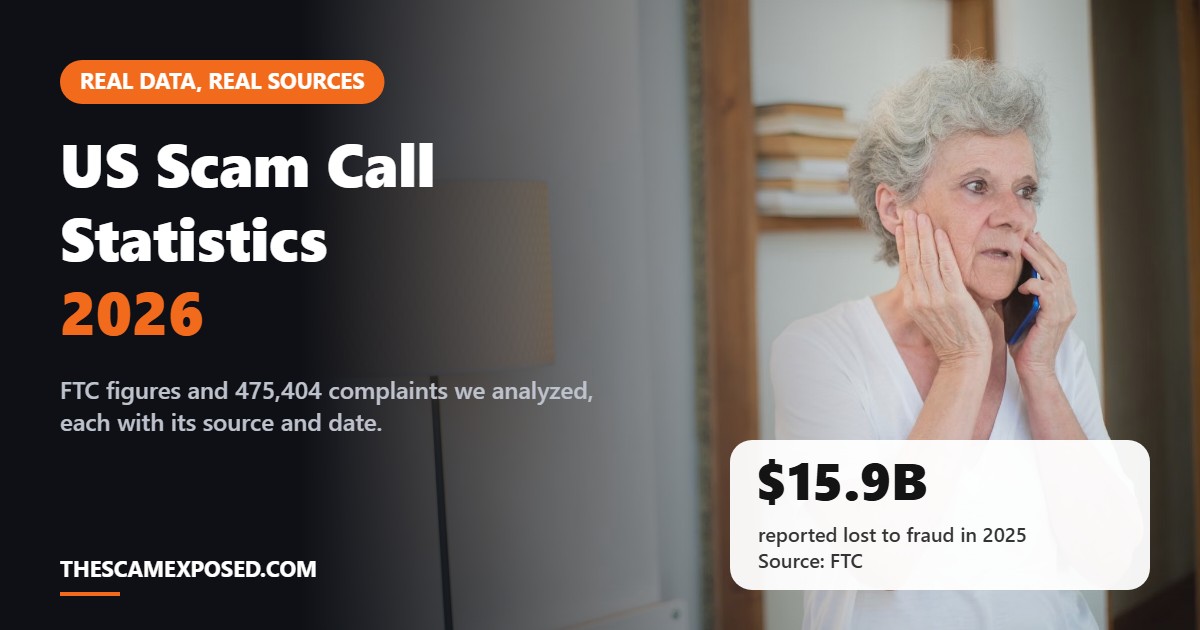
- People in the US reported losing $15.9 billion to fraud in 2025, across 3 million fraud reports to the FTC. Source: FTC, March 2026.
- That compares with 2.6 million fraud reports and over $12 billion in reported losses the year before. Source: FTC, March 2026.
Got a call or text like this? Check the number for free against public FTC and FCC complaint records before you call back or reply.
How much do older adults lose to scams?
- Adults 60 and older reported losing approximately $3 billion to fraud in 2025, up from about $600 million in 2020. Source: FTC Protecting Older Consumers report, October 19, 2026.
- The FTC estimates the overall cost of fraud to older adults in 2025, including unreported losses, could be as high as $119.5 billion. Source: FTC, October 19, 2026.
- The median reported loss for people 80 and over was $2,000. Source: FTC, October 19, 2026.
- Reported investment scam losses among older adults rose 42% in 2025 to over $1 billion. Source: FTC, October 19, 2026.
How much is lost to imposter scams?
- People reported losing $3.5 billion to imposter scams in 2025, nearly three times the 2020 level. Source: FTC, June 15, 2026.
- Reported losses to government impersonators were about $920 million in 2025. Source: FTC, June 15, 2026.
- Reported losses to business impersonators were nearly $1 billion in 2025, with the highest losses tied to bank impersonators. Source: FTC, June 15, 2026.
- Imposter scams were the most reported fraud category, making up nearly one in three fraud reports. Source: FTC, June 15, 2026.
See how bank impersonators use Zelle in our guide to the fake bank fraud alert scam.
What share of scam calls are robocalls?
- 73.2% of unwanted call complaints described a recorded message. Only 26.8% involved a live caller. This is based on 318,716 complaints that stated the call type. Source: our analysis of 475,404 public FTC Do Not Call complaints, snapshot September 28, 2026.
What are the most reported scam call topics?
- Debt reduction was the most reported topic, named in 79,156 complaints, or 23.2% of the 341,530 complaints that listed a topic. Source: our analysis of 475,404 public FTC Do Not Call complaints, snapshot September 28, 2026.
- Impersonation was the second most reported named topic, at 11.5% of complaints with a topic. Source: our analysis of 475,404 public FTC Do Not Call complaints, snapshot September 28, 2026.
Read more about debt relief scam calls and impersonation scam calls.
How long do scammers use one phone number?
- 56% of reported phone numbers (147,089 of 263,003) received exactly one complaint. Source: our analysis of 475,404 public FTC Do Not Call complaints, snapshot September 28, 2026.
- Only 0.4% of reported numbers (1,129) reached ten or more complaints. Source: our analysis of 475,404 public FTC Do Not Call complaints, snapshot September 28, 2026.
- 99.7% of numbers with dated complaints were reported in only one calendar month. Source: our analysis of 475,404 public FTC Do Not Call complaints, snapshot September 28, 2026.
This is why blocking one number rarely stops the calls. You can still check any number for free against the complaints we track.
Which area codes do scam callers use most?
- The six most reported area codes are all toll-free prefixes: 833, 877, 888, 855, 866 and 844. Source: our analysis of 475,404 public FTC Do Not Call complaints, snapshot September 28, 2026.
- Toll-free numbers were 12.8% of reported numbers (33,793) but drew 16.5% of complaints (78,466). Source: our analysis of 475,404 public FTC Do Not Call complaints, snapshot September 28, 2026.
More in our report on toll-free scam numbers and the area codes scam callers use most.
Which states report the most scam calls?
- Florida (32,338), California (29,891) and Texas (27,060) filed the most complaints, together 28.8% of complaints with a state recorded. These are also the three most populous states. Source: our analysis of 475,404 public FTC Do Not Call complaints, snapshot September 28, 2026.
See the numbers for every state on our US scam call map.
How much is lost to text message scams?
- People reported losing $470 million in 2024 to scams that started with a text message, five times the 2020 amount. Source: FTC, April 2025.
- Fake package delivery texts were the most commonly reported type of text scam in 2024. Source: FTC, April 2025.
Learn to spot them in our guide to the 7 common scam texts.
How we researched this page
National figures come from FTC press releases dated March 2026, June 15, 2026 and October 19, 2026, and from FTC text scam data published in April 2025. Figures labeled as our analysis come from 475,404 public FTC Do Not Call complaints about 263,003 phone numbers, mostly filed between July and September 2026, with a snapshot date of September 28, 2026. The full method is explained in our 2026 scam call complaints analysis and on our methodology page. Complaint data reflects what consumers reported and has not been verified call by call. We update this page when new official data is released. The Scam Exposed is an independent educational platform. We are not a government agency, law enforcement body, or legal advisors. Consult official channels for legal recourse.
Read next on this topic
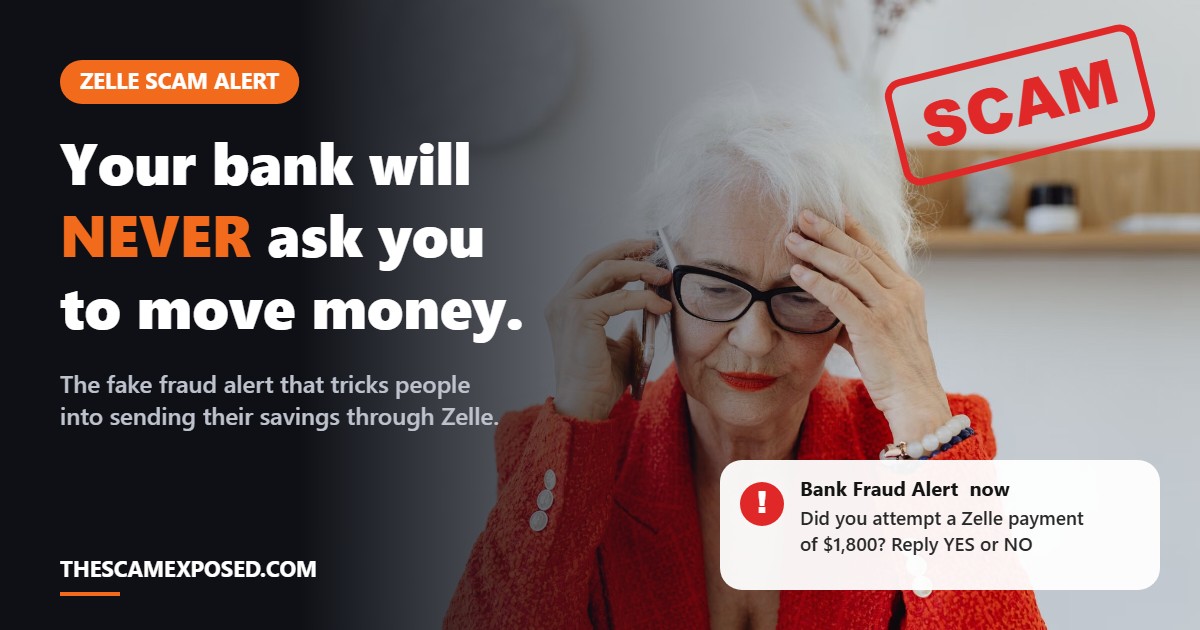 Zelle Scam: The Fake Bank Fraud Alert That Tells You to Send MoneyRead guide →
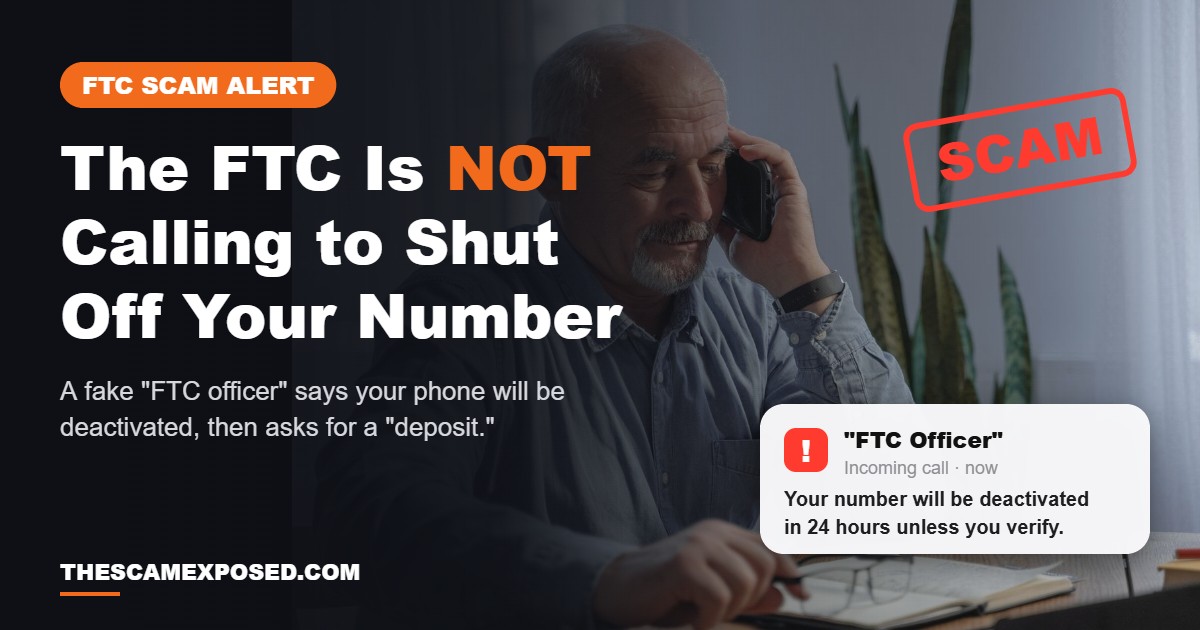 The FTC Is Not Calling to Shut Off Your Phone NumberRead guide →
 That Overpaid Check From a New Client Is a TrapRead guide →
 Is DarkComet Still a Threat in 2026? What US Users Should KnowRead guide →
 The "Easy Online Job" on Telegram That Ends With You Paying in CryptoRead guide →
 Is That Really Social Security Calling? How to Spot Impersonation Scam CallsRead guide →
Share Your Experience
No one has commented yet. If this happened to you as well, say so below. Knowing that other people had the same call makes it far easier for the next person to trust their instincts.
Add Your Comment
Every comment is read by a person before it appears, so it will not show up straight away. Never post your phone number, address, or bank details here.