
The FTC Is Not Calling to Shut Off Your Phone Number
 ·
Published
·
18 min read
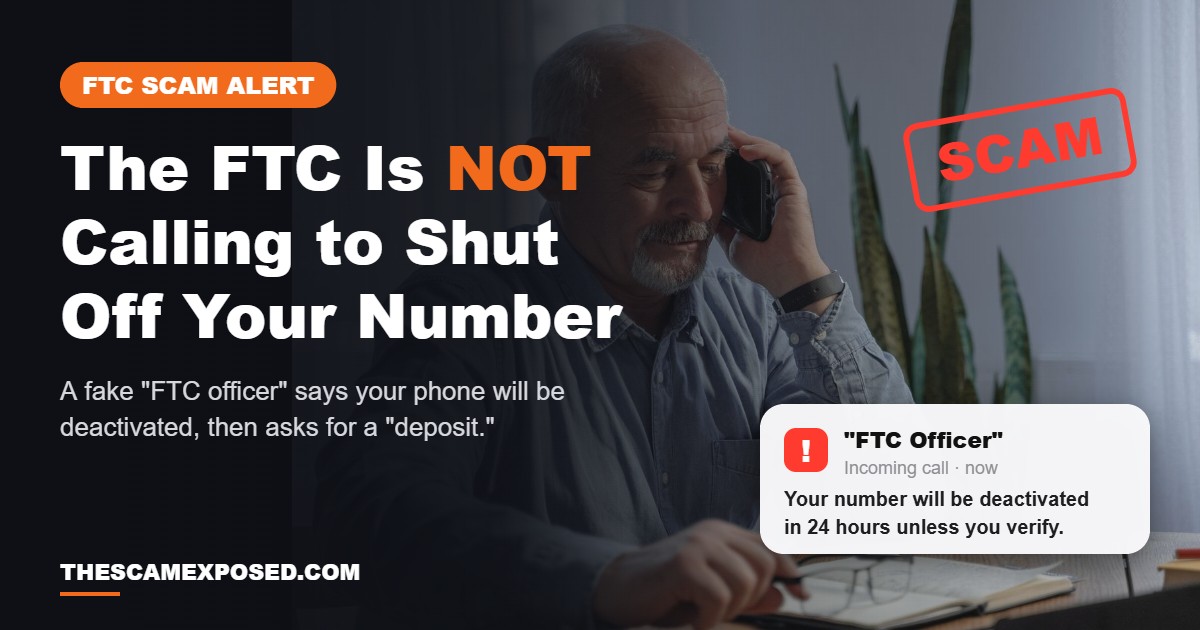
The caller says he works for the Federal Trade Commission. He tells you someone in another country has opened a phone line in your name, it is being used for scams, and unless you cooperate right now, your phone number will be shut off. He even reads you a badge number.
None of it is real. On October 22, 2026, the FTC published a consumer alert with a plain title: The FTC is not calling to deactivate your phone number. In that alert the agency describes the script step by step and says, "None of this is true." The goal, as the FTC lays it out, is to collect your ID and personal details first, and then scare you into sending money as a "security deposit."
I run The Scam Exposed, and most of what I write about starts with a phone call. This one stood out to me because it mixes three fears at once: losing your phone number, being linked to a crime, and being arrested. Below I walk through exactly how the call goes, why it works, what the official data says about government impersonators, and what to do if you have already given them something.
Key takeaways
- The FTC does not call people to deactivate phone numbers, and it does not threaten arrest.
- The scam comes in two parts: first they collect your ID and personal details, then they demand money.
- Callers may tell you to look up the "police department" online. The number you find can be part of the scam.
- People reported losing about $920 million to government impersonators in 2025, according to the FTC.
- If you shared your ID, protect your identity today: report at IdentityTheft.gov and freeze your credit.
In this article (13)
- What the call says
- How the scam unfolds, step by step
- Why this story works on smart people
- What the numbers show
- The fake police number trick
- Red flags
- Real FTC contact vs the scam
- Why they want your ID first
- How to talk to a parent about this call
- If they call you
- Already shared your ID or paid? Do this now
- Common questions
- How we researched this article
What the call says
The opening is built to sound official. Based on the FTC's description, the caller says he is an FTC official and that a phone line has been registered under your name and number. He says that line is being used for scams in another country. To make it believable, he reads out a badge ID number. The FTC says that badge is fake.
Then comes the pressure. If you do not cooperate, he says, your phone number will be deactivated. For a lot of people, especially older adults who use one number for their doctor, their bank and their family, that threat alone is enough to keep them on the line.
Here is a typical version of how the first minute sounds. I wrote this example from the steps the FTC describes. It is not a recording or a transcript.
☎ WHAT THE CALL SOUNDS LIKE (EXAMPLE)
"This is Officer Daniel Brooks with the Federal Trade Commission, badge number 4471. We have a phone line registered in your name that is being used to commit fraud overseas. If we cannot verify your identity today, your number will be deactivated within 24 hours. I am going to transfer you to the police department so you can file a report."
If you heard something like this, hang up. It is a scam.
Notice what that one paragraph does. It gives a name and a number, so it feels like a real person. It makes you the victim of identity theft, so you feel like they are on your side. It sets a deadline. And it moves you to a "police officer," which raises the stakes before you have had time to think.
Got a call or text like this? Check the number for free against public FTC and FCC complaint records before you call back or reply.
How the scam unfolds, step by step
The FTC's alert breaks the scheme into stages. Knowing the order helps, because each stage is designed to make the next one feel normal.
Step 1: The fake FTC official
The first caller claims to be from the FTC and tells you a phone number was registered under your name and is being used for scams in another country. A fake badge number is offered as proof. The threat is that your phone number will be deactivated if you do not cooperate.
Step 2: The transfer to "police"
Next, the impostor transfers you to someone posing as a police officer so you can "file a report." According to the FTC, if you hesitate, the scammers may tell you to call the police department yourself and walk you through finding the number online. The people who answer that number are part of the same scheme.
Step 3: Your ID and a request for secrecy
For the "report," they ask for your ID and other personal information. They also tell you to keep the matter confidential. Secrecy is the tell here. It keeps you from talking to a family member, a bank teller or a friend who would say, "That sounds like a scam."
Step 4: The arrest threat
Later, you hear again. This time you are told you are under arrest for the scams linked to your number, and that you must go to another country. The way out, they say, is to send money as a "security deposit."
Step 5: The money
This is what the whole script was building toward. By now they have your ID, you have been told to keep quiet, and you believe you are in legal trouble. The FTC's message is simple: none of this is true, and the money request is the scam.
| Stage | What they say | What they really want |
|---|---|---|
| 1. Fake FTC official | A line in your name is being used for scams abroad. Your number will be shut off. | Your attention and your fear |
| 2. Fake police transfer | File a report with an officer, or look up the police number yourself. | To make the story feel confirmed |
| 3. ID and secrecy | Send your ID and details. Keep this confidential. | Your identity, and no outside advice |
| 4. Arrest threat | You are under arrest and must travel to another country. | Panic |
| 5. "Security deposit" | Pay to clear your name or avoid arrest. | Your money |
Why this story works on smart people
People who fall for this are not careless. The script is built around real worries, and it borrows details from real life.
It starts by making you the victim. Most people have heard of identity theft, so the idea that someone opened a phone line in your name sounds possible. When the caller presents himself as the person protecting you, your guard drops.
It uses a real agency. The FTC does handle fraud and identity theft reports, so the name fits the story. What the FTC does not do is call people out of the blue, threaten their phone service, or ask for money.
It hands you "proof." A badge number, an officer's name, a police department you looked up yourself. Each piece feels like confirmation, but every piece comes from the scammers.
It isolates you. Being told to keep things confidential is one of the clearest signs of a scam. A real investigation would never depend on you hiding it from your family or your bank.
It escalates slowly. No one asks for money in the first call. They ask for cooperation, then a report, then your ID. By the time money comes up, you have already done several things they asked, and stopping feels harder than continuing.
What the numbers show
Government impersonation is not a small problem, and it hits older adults hardest. These figures come straight from FTC publications.
| Figure | What it means | Source |
|---|---|---|
| About $920 million | Reported losses to government impersonators in 2025, up from $789 million in 2024 | FTC, June 15, 2026 |
| $3.5 billion | Reported losses to all imposter scams in 2025, the most reported fraud category | FTC, June 15, 2026 |
| Over $3 billion | Reported fraud losses by people 60 and older in 2025, up from about $2.4 billion in 2024 | FTC, Protecting Older Consumers 2025 to 2026 |
| $3,000 | Median loss for older adults when the fraud started with a phone call, compared with $599 when it started on social media | FTC report, p. 29 |
| 41% | Share of older adults' aggregate reported phone fraud losses that went to government imposters | FTC report, p. 30 |
| 6,769 | Older adults who reported losing more than $100,000 in 2025. These were 6% of their loss reports but 70% of their total reported losses | FTC report, p. 22 |
Two things jump out at me. First, phone calls lead to bigger losses for older adults than social media does. Second, when older adults lose money over the phone, government imposters account for the largest share of it. A call that claims to be the FTC sits right in the middle of that pattern.
We see impersonation in our own data too. In the public FTC Do Not Call complaint data we analyze, about 1 in 5 scam call complaints in August 2026 (21,195 of 111,844) were about impersonation of a government agency, a bank or a company. You can see the full breakdown in our guide to impersonation scam call numbers.
How we get this data: we import the FTC's public Do Not Call complaint data from the agency's official API every hour and count complaints by the topic people choose when they file them. These are reports from the public, not confirmed cases. You can read more in our methodology.
The FTC also points out that the total cost is likely much higher than what gets reported, because many people never report what happened. In its October 2026 report, the agency estimated that the overall cost of fraud to older adults in 2025 could be as high as $119.5 billion. That is an estimate, not a count, but it shows how many losses never reach a complaint form.
The fake police number trick
The part of this scam that worries me most is the advice to look up the police number yourself. It sounds like the honest thing to do. Most of us have been told, "Hang up and call back on a number you find yourself." Here the scammers use that good advice against you.
According to the FTC, the people who answer the number you find online are also part of the scheme. That means a search result, an ad or a listing can lead straight back to the criminals. The FTC is already looking at this wider problem. On October 1, 2026, it published an advance notice of proposed rulemaking asking whether its Impersonation Rule should be extended to online platforms whose ad tools help government and business impersonation scams. Nothing has changed yet, and public comments are open until November 30, 2026.
So what is safe? Get the number from a source you already trust, not from a search result after a stranger told you to look it up:
- For the FTC, use the contact page on ftc.gov, opening the site by typing the address yourself.
- For local police, use the non-emergency number printed on your city or county government website, or call 911 if you are in danger.
- For your phone service, use the number on your monthly bill or in your carrier's official app.
The simplest test of all: a real agency will never need you to stay on the line while you look up its number.
Red flags
The first four come straight from the FTC's list of things a real FTC employee will never do. If you hear any one of these, you are talking to a scammer.
- Asking for money. A real FTC employee will never ask you to send money, or connect you to someone who does.
- Threatening your phone. The FTC will never threaten to disconnect or deactivate your phone number.
- Demanding secrecy. A real FTC employee will never tell you to keep your conversations secret.
- Texting an ID photo. The FTC will never text you a photo of an employee ID to "verify" who they are.
- Arrest over the phone. No legitimate agency arrests you by phone or offers to cancel an arrest for a payment.
- A "security deposit." There is no deposit, bail or fee you pay a caller to clear your name.
- Travel orders. Being told you must go to another country is a pressure tactic, not a legal process.
One rule that stops this scam: the FTC does not call to shut off your phone number. If someone says they are from the FTC and mentions your phone, money, secrecy or arrest, hang up.
Real FTC contact vs the scam
| Topic | The real FTC | The scam call |
|---|---|---|
| Your phone number | Does not deactivate phone numbers | Threatens to shut your number off |
| Money | Never asks you to send money | Demands a "security deposit" |
| Secrecy | Never asks you to keep it secret | Tells you to keep everything confidential |
| ID | Never texts you a photo of an employee ID | Reads or sends a fake badge number |
| Police | Does not transfer you to an officer to file a report | Transfers you to a fake officer or a fake police number |
| Reports | You report fraud at ReportFraud.ftc.gov when you choose to | They "file a report" for you and collect your details |
Why they want your ID before they ask for money
It can seem strange that the scammers spend so much time on a "report" before they ever mention money. There is a reason for it, and it is the reason this scam can hurt you even if you never pay.
Your ID and personal details have value on their own. With your name, date of birth, address and a photo of your ID, a criminal can try to open accounts in your name, take over accounts you already have, or make a later call to you sound even more convincing. The FTC's alert says the impostors ask for your ID and other personal information for the fake police report. That information is what they collect in stage three, before the arrest threat in stage four.
So if you hung up before paying but had already sent a copy of your ID, you are not out of the woods. Treat it the same way you would treat a lost wallet. The steps in the section below, especially the credit freeze and IdentityTheft.gov, are worth doing the same day.
How to talk to a parent about this call
If you are worried about a mom or dad who picks up every call, a lecture rarely works. A short, specific rule works better. Here is how I would put it:
- Give one sentence to remember. "The FTC never calls to shut off your phone. If anyone says that, hang up."
- Take away the fear of hanging up. Tell them their phone will not stop working because they ended a call. That fear is exactly what the scammers use.
- Agree on a call to you first. Ask them to call you before they send anyone money, a gift card or a photo of their ID, no matter who the caller says they are.
- Make secrecy the alarm. Explain that "keep this confidential" is the clearest sign of a scam. A real agency will never ask them to hide something from family.
- Put it on paper. Keep our printable scam safety card next to the phone with your number written on it.
Keep the conversation light and repeat it now and then. Scammers rely on surprise, and a rule your parent has heard a few times is much easier to remember in the middle of a scary call.
If they call you
- Hang up. You do not need to explain or argue. Ending the call is the safest move.
- Do not call back the number they gave you, and do not search for a number while they are still on the line.
- Do not send your ID, a photo of your ID, or your Social Security number.
- Talk to someone you trust. Tell a family member or friend what the caller said. Scammers count on you keeping it quiet.
- Check your phone account the safe way. If you are worried about your number, call your carrier using the number on your bill or in its official app.
- Report the call at ReportFraud.ftc.gov. Include the number that called and what they said.
- Look up the number in our free scam number lookup to see if others have reported it.
Already shared your ID or paid? Do this now
If you already gave the caller your ID, personal details or money, act quickly. These steps are in the order I would take them.
- If you sent money, call your bank or card company right away using the number on the back of your card. Ask them to stop or reverse the payment and watch your account. If you paid with a gift card, contact the gift card company. If you used a wire transfer or a payment app, contact that company as well.
- If you shared your ID or Social Security number, go to IdentityTheft.gov. It gives you a personal recovery plan.
- Freeze your credit with all three bureaus: Equifax, Experian and TransUnion. A freeze is free and stops new accounts from being opened in your name.
- Protect your phone number. Call your carrier from the number on your bill and ask about adding a PIN or a number lock to your account, so no one can move your number to another phone.
- Report it at ReportFraud.ftc.gov and to the FBI at ic3.gov.
- If you are 60 or older, or helping someone who is, call the National Elder Fraud Hotline at 1-833-372-8311, Monday to Friday, 10:00 a.m. to 6:00 p.m. Eastern. It is free.
- Write everything down: the numbers that called, names and badge numbers they used, what you shared and when. This helps your bank and any report you file.
For a full step by step plan, see our guide on what to do in the first 48 hours after a scam.
Watch for a second scam. People who lose money are often contacted again by someone claiming they can recover it, sometimes posing as a lawyer or another agency. They will ask for a fee. That is a recovery scam. Real help from your bank, the FTC or the FBI does not charge you to get your money back. Read more in our guide to recovery scams that target past victims.
Common questions
Does the FTC ever call to deactivate a phone number?
No. The FTC says a real FTC employee will never threaten to disconnect your phone. Anyone who calls claiming to be the FTC and says your number will be shut off is a scammer.
Can someone really register a phone line in my name?
Identity thieves can open accounts in someone else's name, which is why the story sounds believable. But the FTC does not call you about it, and the fix is never to send money to a caller. If you are worried, check your accounts directly and visit IdentityTheft.gov.
The caller told me to look up the police department myself. Isn't that safe?
Not in this scam. The FTC says the scammers may guide you to a number online, and the people who answer are part of the scheme. Get police numbers from your city or county government website, or call 911 in an emergency.
They read me a badge number. Does that prove anything?
No. The FTC says the badge ID in this scam is fake. A real FTC employee will also never text you a photo of an employee ID to prove who they are.
I gave them a photo of my driver's license. What should I do?
Go to IdentityTheft.gov for a recovery plan, freeze your credit with Equifax, Experian and TransUnion, and watch your accounts. Contact your state motor vehicle agency to ask about your license.
Will my phone actually stop working if I hang up?
No. The FTC does not control your phone service. If you want to be sure your account is fine, call your carrier using the number on your bill or in its official app.
Where do I report this call?
Report it to the FTC at ReportFraud.ftc.gov. If you lost money, also report to the FBI at ic3.gov. People 60 and older can call the National Elder Fraud Hotline at 1-833-372-8311.
How we researched this article
This article is based on the FTC consumer alert "The FTC is not calling to deactivate your phone number" published October 22, 2026, the FTC press release on 2025 imposter scam data published June 15, 2026, the FTC report Protecting Older Consumers 2025 to 2026 published October 19, 2026, the FTC advance notice of proposed rulemaking published in the Federal Register on October 1, 2026, and our own analysis of public FTC Do Not Call complaint data for August 2026. The example call is written from the steps the FTC describes and is not a recording or transcript. All sources were checked on October 28, 2026. The Scam Exposed is an independent educational platform. We are not a government agency, law enforcement body, or legal advisors. Consult official channels for legal recourse.
Read next on this topic
 US Scam Call Statistics 2026: Real Numbers With SourcesRead guide →
 Zelle Scam: The Fake Bank Fraud Alert That Tells You to Send MoneyRead guide →
 That Overpaid Check From a New Client Is a TrapRead guide →
 Is DarkComet Still a Threat in 2026? What US Users Should KnowRead guide →
 The "Easy Online Job" on Telegram That Ends With You Paying in CryptoRead guide →
 Is That Really Social Security Calling? How to Spot Impersonation Scam CallsRead guide →
Share Your Experience
No one has commented yet. If this happened to you as well, say so below. Knowing that other people had the same call makes it far easier for the next person to trust their instincts.
Add Your Comment
Every comment is read by a person before it appears, so it will not show up straight away. Never post your phone number, address, or bank details here.