7 Scam Texts You Should Never Answer
 ·
Published
·
20 min read
·
Published
·
20 min read
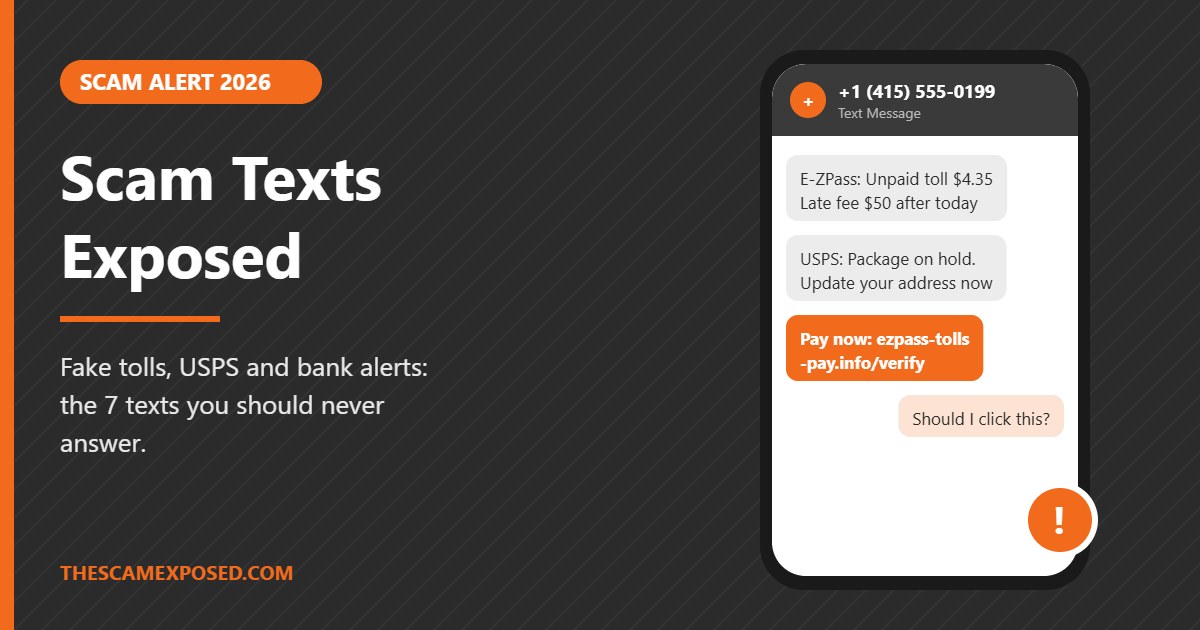
A scam text is short on purpose. Two lines, one link, one deadline. It is designed to be read and acted on in the five seconds between a red light turning green and your foot leaving the brake.
Text messages are where many scams now begin. Unpaid tolls. A package that could not be delivered. A bank asking "Did you attempt a $1,240 Zelle payment? Reply YES or NO." A "Hi, is this Linda?" from a number you do not know.
The FTC says a text message was the top reported way scammers first reached people in 2025. This guide explains the seven scam texts you are most likely to get, the few checks that expose almost all of them, how to respond safely, and exactly what to do if you already tapped the link, replied, or paid.
Key takeaways
- When people told the FTC how a scam first reached them in 2025, a text message was the most common answer.
- Reported losses to text scams hit $470 million in 2024, more than five times the 2020 figure, according to the FTC.
- Fake toll notices drove a 40% jump in government imposter reports in 2025.
- Do not tap links, call numbers, or reply to unexpected texts, not even "STOP." Check the account through the official app or a number you already trust.
- Forward scam texts to 7726 (SPAM), then delete them. If you paid or shared details, call your bank first.
What a scam text really is
"Smishing" is phishing by SMS, the technical name for a text message. The idea is the same as a phishing email: pretend to be someone you trust and get you to hand over a card number, a password, a one time code, or money.
Texts have a few advantages for scammers over email. Phones have weaker spam filtering for texts than email providers have for inboxes. Links in texts are short and hard to inspect. People read nearly every text, often within minutes. And a text feels personal in a way an email does not, because it arrives on the same screen as messages from your family.
Where scam texts come from
Most scam texts are sent in bulk from computers using huge lists of numbers. Some lists come from data breaches. Others are simply every possible number in an area code. That is why you can get a scam text about a toll road you have never used or a bank you have never banked with. The sender is not targeting you. They are targeting everyone and waiting for the few people the story happens to fit.
Some texts now arrive through messaging apps such as iMessage, RCS, or WhatsApp instead of plain SMS. These can come from email addresses or foreign numbers, and they can slip past carrier filters. The advice in this guide applies to all of them.
How much money scam texts cost
| Measure | Figure | Source |
|---|---|---|
| Top reported first contact method in 2025 fraud reports | Text message | FTC testimony, March 2026 |
| Reported losses to text scams, 2024 | $470 million | FTC Data Spotlight |
| Growth in text scam losses, 2020 to 2024 | More than 5 times | FTC Data Spotlight |
| Increase in government imposter reports, 2025, driven partly by toll texts | 40% | FTC, May 2026 |
| Total fraud losses reported to the FTC, 2025 | $15.9 billion | FTC testimony, March 2026 |
| Losses to bank impersonators, 2025 | Nearly $1 billion | FTC, June 2026 |
| Government and police impersonation losses, Jan 2025 to July 2026 | More than $1.6 billion | FBI IC3, Sept 2026 |
What these numbers tell me is simple. Texts are now the most common front door for fraud in America, and the losses behind that door are growing fast. The FTC also noted something odd in 2024: the number of text scam reports went down, while the money lost went up. Fewer, better targeted texts are doing more damage.
As always, these are reported losses. Most victims never report, so the true figures are much larger.
Why scam texts work so well
They fit into real life
Most of us really are waiting on a package. Many of us really did drive through a toll last month. Most of us really do have a bank account. A scam text only needs to match one thing you half remember to feel real.
They are tiny
An email has room for mistakes: odd grammar, a wrong logo, a strange footer. A text has two lines. There is very little to check, so the usual warning signs are missing.
The link hides where it goes
Scam links are often shortened or use addresses like "usps-redelivery-help.com" or "ezpass-tolls-pay.info." On a small screen, they look official enough. Once you tap, the page that opens looks exactly like the real company's site.
They create a small, urgent problem
"$3.15 unpaid toll. A $50 late fee applies after today." Nobody wants a late fee, and $3.15 feels too small to bother checking. That is the point. The small amount gets your card number. The card number is what they want.
The rule that beats every scam text: The text is never the place to fix the problem. If it might be real, close the text and check through the company's official app, website you type yourself, or a phone number you already trust.
The 7 scam texts Americans get most
The FTC's own list of top text scams, plus what readers send us, comes down to these seven. For each one, here is what it says, what it wants, and how to check it.
1. The unpaid toll
What it says: "E-ZPass: You have an outstanding toll of $4.35. Pay by today to avoid a $50 late fee and suspension of your registration."
What it wants: Your full card number, and sometimes your driver's license and Social Security number. The FBI first warned about these in April 2024, after more than 2,000 complaints in about a month. In 2025, toll texts helped push government imposter reports up 40%.
The check: Toll agencies send bills by mail or through their own app or account. Open your toll account by typing the agency's address yourself. Our article on the unpaid toll text scam shows real examples.
2. The package that could not be delivered
What it says: "USPS: Your package is on hold due to an incomplete address. Update within 12 hours or it will be returned."
What it wants: A small "redelivery fee" paid by card, which hands over your full card details. The FTC ranked fake delivery texts as the number one text scam of 2024.
The check: Copy the tracking number, if there is one, into the carrier's own app or website. The USPS does not text you about delivery problems unless you signed up with a tracking number first, and it never asks for payment by text.
3. The fake fraud alert from your bank
What it says: "Chase Fraud Alert: Did you attempt a Zelle payment of $1,240.00 to Mark T.? Reply YES or NO."
What it wants: A reply, then a phone call. When you reply NO, a "fraud specialist" calls within minutes. The caller ID may even show your bank's real number. They tell you your account is compromised and walk you through "securing" your money, which means sending it to them, or reading back a code your bank just texted you.
The check: Do not reply. Call the number on the back of your card. Banks do send real fraud alerts, but a real bank will never ask you to move money to keep it safe. Nearly $1 billion was lost to bank impersonators in 2025. We covered a newer version in our article on fake bank callers who send couriers to your door.
4. The job offer
What it says: "Hi, I am a recruiter. We have flexible part time work, $200 to $500 a day, 60 to 90 minutes. Interested?"
What it wants: Your time first, then your money. These are often "task scams," where you rate products or "boost" apps in an online dashboard. You see earnings pile up, but to unlock them you must deposit money, usually in crypto. The deposits grow until you stop. The FTC lists this among the top text scams.
The check: Real employers do not recruit by random text, and no real job asks you to pay to get paid.
5. The "wrong number"
What it says: "Hi Amy, are we still on for dinner Thursday?" When you reply that they have the wrong number, they apologize warmly and keep chatting.
What it wants: A friendship that becomes a romance or an investment pitch weeks later. Eventually they show you a crypto trading platform where they "make a lot of money." The platform is fake. FTC data shows people lost tens of thousands of dollars each to this pattern.
The check: You do not need to reply to wrong number texts at all. If a friendly stranger ever brings up investing, stop.
6. The government or court notice
What it says: "Notice from the Department of Motor Vehicles: You have an unpaid traffic ticket. Pay now to avoid license suspension." Or a text about missed jury duty or a warrant.
What it wants: A payment, or a phone call to a fake officer. The FBI said in September 2026 that it received nearly 61,000 complaints about government and police impersonation from January 2025 to July 2026, with losses over $1.6 billion. The FBI is direct: law enforcement and government agencies will never contact you by phone or text to demand payment.
The check: Look up the agency yourself and call its official number. Courts and DMVs send letters.
7. The account problem or prize
What it says: "Your Apple ID has been locked." "Your Netflix payment failed." "You have won a $500 Walmart gift card."
What it wants: Your login password or card details on a fake page.
The check: Open the app. If your payment really failed, the app will tell you. If you did not enter a contest, you did not win one.
A typical case, start to finish
The story below is a composite built from the pattern readers describe to us. The details are illustrative, but each step is real.
A nurse in Ohio finishes a night shift and checks her phone in the parking lot. There is a text: "Ohio Turnpike: Unpaid toll balance of $6.99. Late fee of $45 will be added at midnight." She did use the turnpike last week. She taps the link.
The page looks official, with the right colors and a search box for her plate number. She types her plate, and it "finds" her balance. She enters her card number, expiry date, and the three digit code. Then the page asks for her ZIP code and date of birth "to verify identity." She enters those too. A green check mark appears.
Two days later her bank calls about $1,800 in charges at electronics stores in three states. The card is canceled and she gets most of the money back, but now the scammers have her name, address, card details, and date of birth. A month later, she starts getting calls about a loan she never applied for.
The warning signs were there. Toll agencies bill by mail or through their own accounts. The web address was not the agency's real site. The page asked for her date of birth, which no toll payment needs. And the deadline was midnight, which exists only to stop you from checking.
Newer tricks to watch for in 2026
Scam texts keep changing as phones get better at filtering them. These are the newer patterns showing up in reader submissions.
"Reply Y to activate the link"
Phones often disable links in texts from unknown senders. So scammers now write, "Please reply Y, then exit and reopen this message to activate the link." Replying tells your phone you trust the sender, which turns the link back on. No real company asks you to do this.
Messages from email addresses
Some scam texts now come from an email address rather than a phone number, especially on iPhones. This can get around carrier filters and the 7726 reporting system. Treat them exactly like any other unexpected text: do not tap, do not reply.
Texts that move you to another app
Job and investment scams often start with a text and then ask you to continue on WhatsApp, Telegram, or Signal. Moving the conversation off your normal messages makes it harder for anyone to step in, and harder for the platform to warn you. A request to switch apps is a red flag on its own.
Real numbers in the caller ID
After a fake bank text, the follow up call may show your bank's real phone number. Caller ID can be spoofed. A real number on your screen does not prove a real person is on the line. Hang up and call the number on your card.
QR codes and images
Some texts now send a picture or a QR code instead of a written link, because filters read text more easily than images. A QR code from an unknown sender is just a link in disguise.
Red flags in any text message
- You were not expecting it. Unexpected texts about money or accounts are the biggest single warning sign.
- It has a link. Banks, the USPS, toll agencies, and the government very rarely text you a link to pay or verify.
- There is a deadline. Today, 12 hours, midnight, "final notice."
- The sender is odd. An email address, a long number, or a foreign number instead of a short code you recognize.
- The web address is close but wrong. Extra words, hyphens, or endings like .info, .top, .xyz, or .vip.
- It asks you to reply YES or NO. This is often the start of a bank impersonation call.
- It asks for a code. Anyone who asks you to read back a code sent to your phone is trying to get into your account.
- It offers easy money. High pay for little work, prizes you did not enter for, or a stranger who wants to teach you to invest.
- Payment by gift card, crypto, wire, or payment app. Real agencies and companies do not ask for these to fix a problem.
Real text vs scam text
| Feature | Real text | Scam text |
|---|---|---|
| Did you sign up for it? | Yes, you opted in | No |
| Sender | Usually a short code you recognize | Random number or email address |
| Link to pay or verify | Rare | Almost always |
| Deadline and penalty | Rare | Very common |
| Asks for full card, SSN, or code | Never | Often |
| Same message visible in the app | Yes | No |
| Reply YES or NO, then a phone call | Possible for real alerts, but they never ask you to move money | Common setup for bank impersonation |
How to respond to a suspicious text
- Do not tap the link. Not even to "see what it is."
- Do not reply. Not YES, not NO, not STOP. A reply confirms your number is active and in use. Real businesses you signed up with honor STOP, but scammers use it to mark you as a live target.
- Do not call any number in the text. It goes to the scammer.
- Check the claim another way. Open the official app, type the website yourself, or call the number on your card, bill, or the agency's official site.
- Report it. Forward the text to 7726 (it spells SPAM). This tells your carrier to block the sender. You can also report it at ReportFraud.ftc.gov, and toll scams to IC3.gov, as the FBI asks.
- Delete it. And use your phone's "Report Junk" option if it appears.
Got a number or website from a text and want a second opinion? Paste it into our free scam checker to see whether others have reported it.
How to cut down scam texts
You cannot stop every scam text, but you can cut the number a lot.
- Turn on your phone's filters. On iPhone, go to Settings, Apps, Messages, and turn on "Filter Unknown Senders." On Android, open Google Messages, then Settings, then Spam protection, and turn it on.
- Turn on your carrier's free blocking. AT&T, Verizon, and T-Mobile all offer free spam blocking apps. Our guide to free carrier scam blocking walks through each one, and our guide to phone settings that stop scam calls covers the rest.
- Report every scam text to 7726. Each report helps carriers block the sender for everyone.
- Be careful where you share your number. Contest entries, store loyalty forms, and "free gift" sites often sell or leak numbers.
- Use two step verification with an app, not texts, where you can. If a scammer steals your number through a SIM swap, text codes stop being safe. Authenticator apps and passkeys avoid that risk.
- Ask your carrier for a port out PIN or number lock. This makes it much harder for someone to move your number to their phone.
How to help a parent or grandparent with scam texts
Many of the readers who write to me are not asking for themselves. They are asking for a mother who taps every link, or a grandfather who replied to a "wrong number" and now chats with a stranger every morning. The FBI says people 60 and older reported $7.75 billion in losses in 2025, more than any other age group, so this worry is well founded.
Set up the phone together
Sit down with them for twenty minutes and turn on the protections from the section above: unknown sender filtering, the carrier's free blocking app, and automatic software updates. Then put the real numbers for their bank, card, and pharmacy into their contacts with clear names like "Bank, real number." When a text says to call, they will have a trusted number ready.
Give them one rule, not ten
Long lists of warning signs are hard to remember under pressure. One rule works better: "If a text asks you to pay, click, or call about money, show it to me first." Make it clear you will never be annoyed by a false alarm. People hide scams when they feel embarrassed, and silence is what scammers count on.
Watch for the slow scams
The most expensive text scams are not the quick toll links. They are the friendships that start with "wrong number" and grow over weeks. Signs to look for include a new friend they have never met who lives far away or overseas, talk of a special investment app, requests to keep the friendship private, and new purchases of gift cards or crypto. If you see these, ask gentle questions instead of giving orders. A person who feels judged often defends the scammer.
Practice once
Show them a real scam text, such as one of the examples in this guide, and walk through what they would do. Practicing once with no pressure makes the right response feel natural when a real one arrives.
Already clicked, replied, or paid? Do this now
Please do not blame yourself. These texts are tested on millions of people until they work. What matters now is acting quickly. Do the steps that match what happened.
If you only tapped the link
- Close the page without typing anything.
- Update your phone's software.
- Do not install any app or profile the page asked you to install. If you did, remove it.
If you replied to the text
- Stop replying. Block the number.
- Expect more scam texts and calls for a while. Do not answer calls claiming to be your bank about that text. Call your bank yourself.
If you typed card details
- Call your card issuer now, using the number on the back of your card. Ask them to cancel the card and review recent charges.
- Watch your statements closely for the next few months.
If you shared your SSN, date of birth, or a login
- Change the password for that account from a trusted device and turn on two step verification.
- Freeze your credit at Equifax, Experian, and TransUnion. It is free.
- Go to IdentityTheft.gov for a step by step recovery plan.
If money has left your account
- Call your bank immediately and ask them to stop or recall the transfer. With wires and Zelle, every hour counts.
- Report to the FBI at IC3.gov and to the FTC at ReportFraud.ftc.gov.
- If you are 60 or older, call the National Elder Fraud Hotline at 1-833-372-8311 for free help.
Our step by step page on the first 48 hours after a scam explains what to say to your bank and which deadlines matter.
Watch for the second scam. People who lose money to scam texts often get a follow up from someone promising to recover it, for a fee. These "recovery agents," "lawyers," and fake government officials are scammers too. No real agency charges you to get your money back. Read our guide on recovery scams that target past victims.
FAQ
Can my phone get hacked just by opening a scam text?
On an updated phone, simply reading a text is very unlikely to harm you. The risk comes from tapping links, entering details, installing apps, or calling numbers. Keep your phone's software up to date.
Should I reply STOP to a scam text?
No. STOP works for real businesses you signed up with, but for scam texts a reply confirms your number is active. Forward the text to 7726 and delete it instead.
How do scammers get my phone number?
From data breaches, data brokers, public records, and sometimes by simply texting every number in an area code. Getting a scam text does not mean anyone has hacked you.
Is the E-ZPass or toll text I got real?
Almost certainly not, if it came with a link and a deadline. Toll agencies bill by mail or through their own app or online account. Log in to your toll account yourself to check for any real balance.
Does the USPS send text messages?
Only if you signed up for tracking updates with a specific tracking number. The USPS will not text you asking for payment or for a new address with a link.
What is 7726 and does reporting there help?
7726 spells SPAM on a keypad. Forwarding a scam text there sends it to your carrier, which uses the reports to block senders. It is free on all major US carriers.
My bank texted me about fraud. How do I know if it is real?
Do not use any link or number in the text. Open your bank's app or call the number on the back of your card. A real bank may ask if you made a charge, but it will never ask for your PIN or a one time code, or ask you to move money to protect it.
Can scammers fake the name that shows on a text?
Yes. Some messaging apps let senders choose a display name, and messages can appear inside the same thread as real alerts from a company. Always verify through the official app, not the text thread.
How we researched this article
This guide draws on Federal Trade Commission data and testimony published in 2025 and 2026, including its Data Spotlight on top text scams, FBI Internet Crime Complaint Center public service announcements on toll smishing and government impersonation, and the scam texts our readers send us for review. The typical case is a composite of reader reports, with details changed. Figures are reported losses and undercount the true total. Phone setting menus can change with software updates. This article is for general education and is not legal or financial advice. Written by Nitesh Kumar Gupta, Founder and Editor of The Scam Exposed.
Read next on this topic
 How to Tell a Fake Bank, Amazon or IRS Email in SecondsRead guide →
 That Firebase Storage Link in Your Email Is PhishingRead guide →
 How the Microsoft Tech Support Scam Call and Pop-Up Really WorkRead guide →
 That Overpaid Check From a New Client Is a TrapRead guide →
 Is DarkComet Still a Threat in 2026? What US Users Should KnowRead guide →
 The Medicare Calls Hitting Seniors This Fall, and How to Shut Them DownRead guide →
Share Your Experience
No one has commented yet. If this happened to you as well, say so below. Knowing that other people had the same call makes it far easier for the next person to trust their instincts.
Add Your Comment
Every comment is read by a person before it appears, so it will not show up straight away. Never post your phone number, address, or bank details here.