
Text Says Your Package Cannot Be Delivered? Do This First
 ·
Published
·
21 min read
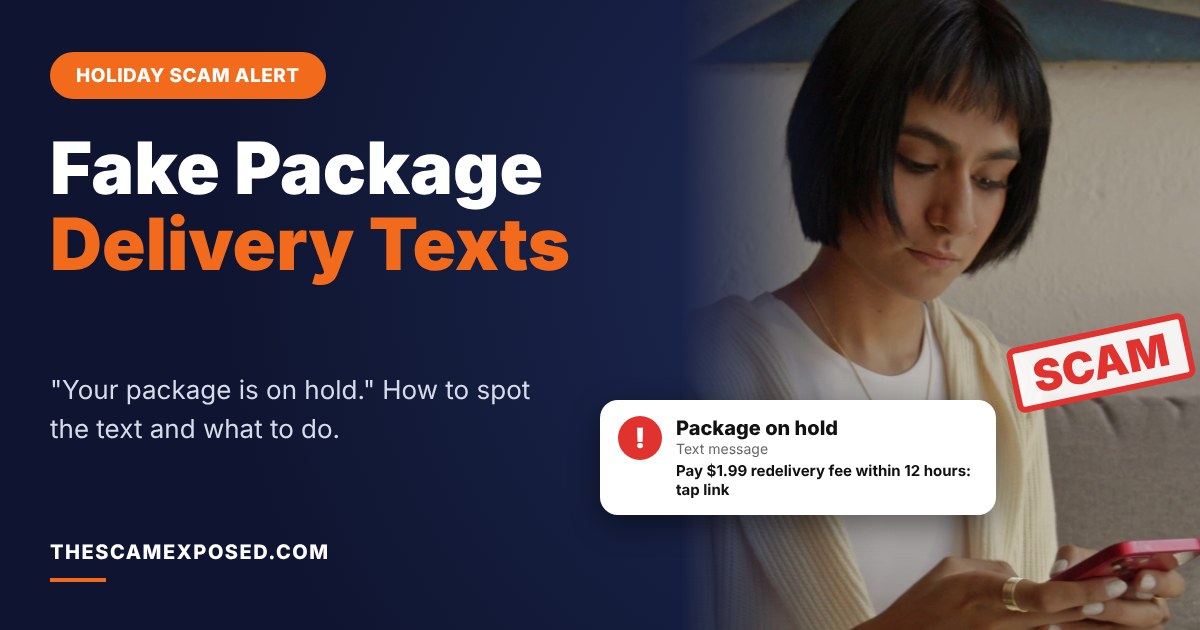
Short answer: The U.S. Postal Inspection Service says USPS does not text or email you unless you first asked for updates with a tracking number, and those messages do not contain a link. If a text says your package is on hold and asks you to click a link or pay a small fee, do not click. Check the tracking number on the official carrier website yourself.
A text arrives saying your package could not be delivered because the address is incomplete. It asks you to tap a link and pay a small redelivery fee. During the holiday shopping season, when almost everyone is waiting for something, that message looks completely normal. That is why it works.
At The Scam Exposed, the questions we get from readers in November and December follow a pattern: "I got a USPS text about my package. Is it real?" or "I paid a $1.99 fee for redelivery and now my card has strange charges. What do I do?"
This guide explains how the fake package delivery text works, the warning signs, what a real carrier will and will not do, and exactly what to do if you already clicked or paid. Every fact here comes from an official source, mainly the U.S. Postal Inspection Service (USPIS), the Federal Trade Commission (FTC) and the FBI Internet Crime Complaint Center (IC3). The sources are linked where they are used.
Key takeaways
- According to the U.S. Postal Inspection Service, USPS will not text or email you without you first requesting it with a tracking number, and those messages will not contain a link.
- Fake package delivery alerts were the most commonly reported text scam in 2024, according to FTC data published in April 2025.
- The small "redelivery fee" is bait. The real goal is your full card number, your personal details or a one-time code.
- Never pay or type card details on a page you reached from a text. Open the carrier's app or type its website address yourself.
- If you already entered card details, call the number on the back of your card right away and ask for a new card.
- Forward the text to 7726 (SPAM). For USPS-themed texts, you can also email the details to [email protected].
Already typed your card number into a delivery page? Stop reading and call the number on the back of your card now. Ask the issuer to block the card and send a new one. Then come back to the step-by-step recovery section.
In this article (15)
- Why delivery texts work so well in the holiday season
- How the fake package delivery text works
- Anatomy of a fake delivery text
- Read a fake delivery text line by line
- What the official data shows, and what it does not
- Why a tiny fee is the real trap
- Red flags checklist
- Real carrier message vs scam text
- Why the link cannot be trusted
- What to do when the text arrives
- Already clicked or paid? Do this now
- If there really is a problem with your package
- Helping a parent or grandparent
- Simple habits that stop most delivery scams
- FAQ
- How we researched this article
Why delivery texts work so well in the holiday season
Most scams have to create a reason for you to act. A delivery problem text does not need to work hard. In late November and December, many people are expecting several packages at once, from different stores, through different carriers.
Three things make this scam believable.
You probably are waiting for something. The scammer does not know what you ordered. They do not need to. If you ordered anything online in the last week, a text about a package feels relevant.
The fee is small. A charge of a dollar or two does not feel like a big risk. Many people think, "Even if something is wrong, it is only two dollars." That thinking is exactly what the scammer wants.
The page looks official. The link usually opens a page with a carrier logo, a tracking-style layout and a simple form. On a small phone screen, it is hard to notice that the web address is wrong.
Put together, the text feels like a routine chore, not a threat. That is what makes it more dangerous than a scary call. You are not on guard.
Got a text like this? Check the sender's number for free against public FTC complaint records before you reply or click.
How the fake package delivery text works
The details change from message to message, but the pattern is the same. Here is how it usually goes, based on the descriptions published by USPIS and the FTC.
- The text. You get a message that appears to come from USPS, UPS, FedEx, DHL or a "delivery service." It says your package is on hold, could not be delivered, or has an address problem.
- The urgency. The text says the package will be returned or destroyed unless you act within a short time, often 12 or 24 hours.
- The link. You are asked to tap a link to "update your address" or "schedule redelivery." The link often uses a strange web address that only looks a little like the real carrier.
- The form. The page asks for your name, address, phone number and email. That alone gives the scammer useful personal data.
- The fee. The page then asks for a small redelivery or customs fee and requests your full card number, expiry date and security code.
- The follow-up. Some pages then ask for a one-time code sent to your phone. That code can let the scammer add your card to their own wallet or approve a larger payment.
After that, the charges you see may be much larger than the fee you agreed to, or they may appear days later. Your personal details can also be reused in other scams, including fake bank fraud calls that already know your name and address.
Why it works on careful people
People who are usually careful with phone calls still fall for delivery texts. The reason is simple. Nobody is shouting at them. The text sounds helpful, the fee is tiny, and the task feels like something they have done before with real deliveries. Being careful about scary calls does not protect you from a message that feels boring.
Anatomy of a fake delivery text
Below is an example written by The Scam Exposed to show the typical pattern. It is not a copy of any single real message, and the web address is made up on purpose. Real scam texts change wording all the time, but the parts are almost always the same.
Example message:
"USPS: Your package is on hold at our warehouse due to an incomplete address. Please confirm your details within 12 hours or it will be returned: usps-redelivery-help[.]top. Redelivery fee: $1.99."
- "USPS:" at the start. Anyone can type a company name at the start of a text. It proves nothing.
- "On hold" and "incomplete address." A vague problem that could apply to anyone, so it fits whatever you ordered.
- "Within 12 hours." A deadline to stop you from checking your real orders.
- A link at all. USPIS says USPS tracking texts you request do not contain a link. Any link in a USPS-branded text is a warning sign.
- The web address. It contains the carrier's name but is not the carrier's real website. Extra words and unusual endings are common.
- No tracking number. A real update is tied to a shipment you can look up yourself.
- A tiny fee. Small enough that you do not think twice, which is the whole point.
If you can spot even two of these seven parts in a message, you can stop there. You do not need to prove it is fake. You only need to check your order the safe way.
Read a fake delivery text line by line
Below is an illustrative example written by The Scam Exposed. It is not a copy of a real message, but it follows the pattern described by USPIS and the FTC. Each line has a job, and once you see the job, the trick stops working.
| What the text says | What it is really doing |
|---|---|
| "USPS: Your package has arrived at the warehouse but cannot be delivered." | Uses a trusted name and a believable problem. No tracking number you can check. |
| "The address information is incomplete." | Gives you a reason to type your full address and contact details. |
| "Please update within 12 hours or the package will be returned." | Creates a deadline so you act before you think. |
| A link that starts with the carrier's name followed by extra words and an unusual ending | Looks close enough to the real site on a small screen. The real domain is the part right before the first single slash, and it is not the carrier's. |
| "Reply Y and reopen this message to activate the link." | iMessage disables links from unknown senders. Replying can switch the link on and confirms your number is active. |
| "A $1.99 redelivery fee applies." | The small fee is the reason to ask for your full card number and security code. |
The "reply Y" line is worth remembering. Apple's iMessage turns off links in texts from unknown senders you have never replied to. A reply can turn the link back on, and Malwarebytes reported in January 2025 that USPS-themed scam texts were using exactly this trick. No real carrier needs you to reply to a text before you can track a package.
The 60-second check: Do I have a tracking number from my own order? Does the official carrier app or website show a problem when I type that number myself? If the answer to either is no, the text is not your delivery.
What the official data shows, and what it does not
There is no single official count of fake delivery texts for 2025. Here is what the most recent official reports do say, and the period each one covers.
| Finding | Period | Source |
|---|---|---|
| Fake package delivery alerts were the most commonly reported text scam | 2024 | FTC, April 2025 |
| People reported losing $470 million to scams that started with a text | 2024 | FTC, April 2025 |
| Text messages were the contact method people reported most often in fraud reports | 2025 | FTC testimony, March 2026 |
| Phishing and spoofing drew more complaints than any other crime type (191,561 complaints) | 2025 | FBI IC3 2025 Internet Crime Report |
Two points matter when reading these figures. First, they only count what people reported. Many people who lose a few dollars never report it at all. Second, the FTC's ranking of top text scams covers 2024. It is the most recent text-specific ranking the FTC has published that we could find. We do not present it as a 2025 or 2026 finding.
What the data does show clearly is that text messages are now a main doorway for fraud, and that delivery alerts are one of the most common disguises.
Why a tiny fee is the real trap
The fee is not the point. A scammer does not send thousands of texts to collect two dollars from each person. The fee is a reason to get you to type in things that are worth far more.
- Your full card details. Card number, expiry date and security code can be used for larger purchases or sold to other criminals.
- A one-time code. If the page asks for a code that was just texted to you, the scammer may be using it to add your card to a digital wallet or to approve a payment you never agreed to.
- Your personal details. Name, address, phone and email help the scammer make later calls and texts sound real.
- Proof that your number is active. Even replying "STOP" or "wrong number" can tell the sender a real person reads that number.
This is why the advice is the same whether the fee is $0.30 or $30. Do not enter anything on a page you reached from an unexpected text.
The 30-second check: Close the text. Open the store's app or your order email. Copy the tracking number. Paste it into the carrier's official app or a website address you typed yourself. If there is no problem there, there is no problem.
Red flags checklist
- You never signed up for text updates. USPIS says USPS does not text you unless you first requested it with a tracking number.
- The text contains a link. USPIS says USPS tracking texts you request will not contain a link.
- A fee to redeliver or release a package. Treat any surprise fee request in a text as suspicious.
- A short deadline. "Within 12 hours" or "today only" is meant to stop you from checking.
- No tracking number, or one you do not recognize. A real update refers to a shipment you can look up yourself.
- A strange sender. Messages from an email address, a long number or an international number deserve extra suspicion.
- A web address that is almost right. Extra words, odd spellings or unusual endings in the address are warning signs.
- A request for a one-time code. No delivery service needs a code that your bank or phone just sent you.
- Odd grammar or formatting. Not always present, but worth noticing.
One red flag is enough to stop and check. You do not need to find all of them.
Real carrier message vs scam text
| Real carrier update | Scam text |
|---|---|
| Arrives because you signed up with a tracking number (for USPS, per USPIS) | Arrives out of nowhere |
| USPS tracking texts do not contain a link (per USPIS) | Pushes you to tap a link |
| Refers to a tracking number you can check yourself | Vague "your package" with no usable details |
| Lets you check on the official app or website | Only works through the link in the text |
| Does not ask for a code sent to your phone | Asks for a one-time code |
| Gives you time to check | Threatens return or destruction within hours |
Rules differ between carriers, and private carriers have their own notification systems. The safe habit works for all of them: never act on the link. Open the carrier's app or type its website address yourself and check the tracking number there.
Why the link cannot be trusted
A link in a text can show one thing and open another. The page it opens can copy a carrier's logo, colors and layout exactly. A padlock icon in the browser only means the connection is encrypted. It does not mean the site belongs to the company it claims to be.
The sender's name or number cannot be trusted either. Scam texts can come from many different numbers, and some arrive through email-to-text or messaging services. Blocking one number rarely stops the next message.
The only reliable check is one you start yourself, using an address or app you already know is real. For more on how scam texts are built, see our guide to scam text messages. A related disguise is the unpaid toll text, which uses the same link-and-fee trick.
What to do when the text arrives
The steps are the same whether you are sure it is a scam or only unsure. You do not have to decide. You only have to check in a safe way.
- Do not tap the link. Not even to "see what it says."
- Do not reply. Not "STOP," not "wrong number," not anything.
- Check your orders yourself. Open the store's app or your order confirmation email and find the tracking number there.
- Track it on the official site. Type the carrier's website address yourself or open its official app. Enter the tracking number.
- Report the text. Forward it to 7726 (SPAM), as the FTC recommends. You can also use the "Report junk" option in your messaging app.
- For USPS-themed texts. The Postal Inspection Service asks you to email [email protected] with the message text copied in (without clicking the link), your name, and a screenshot showing the sender and date.
- Delete it. Once reported, delete the message so nobody else in the house taps it later.
If your tracking shows a real problem, deal with it through the official site or app only.
Already clicked or paid? Do this now
Act quickly. Speed matters more than anything else here. These steps follow the FTC's guidance on what to do if you were scammed. Taking them does not guarantee you will get money back, but it gives you the best chance and limits further damage.
You only tapped the link
If you opened the page but did not type anything, close it. Do not download anything the page offered. Keep your phone's software up to date. Watch for more messages, because the sender now knows your number is active.
You entered card details
Call the number on the back of your card right away. Tell the issuer the card details were entered on a scam site. Ask them to block the card, issue a new one and review recent charges. Dispute any charge you did not make. See our step-by-step guides for a credit card or a debit card.
You shared a one-time code
Tell your bank or card issuer that you gave a code to a scam site. Ask whether a new device or digital wallet was added to your card or account, and ask them to remove it. Change the password for any account linked to that code.
You entered your personal details
If you entered your Social Security number, date of birth or a login, go to IdentityTheft.gov for a recovery plan. Consider a free credit freeze with each of the three credit bureaus. Expect more scam calls and texts that use your real details, and treat them with suspicion.
You paid another way
If the page pushed you to pay by bank transfer, payment app, gift card or crypto, contact that company immediately and ask them to stop or reverse the payment. Our lost money guide has steps for each payment method.
Protect your accounts
If you used the same password anywhere on that page, change it everywhere you use it. Turn on two-step verification for email and banking.
Report it
Report what happened to the FTC at ReportFraud.ftc.gov and to the FBI IC3. For USPS-themed scams, also email [email protected] as described above. You can also report the number to The Scam Exposed so other readers can see it when they search.
Watch out for a second scam. After a loss, some people are contacted by someone promising to recover the money for a fee, or by a caller pretending to be from the bank fraud team who asks for another code. Your real bank will not ask you to read out a one-time code. Read about the recovery scam that targets past victims.
If there really is a problem with your package
Sometimes a package really is delayed, damaged or missing. You can still fix it without touching a link from a text.
- Start from the order. Use the tracking number in the store's app or your order confirmation email.
- Use the official carrier site or app. Type the address yourself or open the app you already have installed.
- Contact the seller. If tracking shows a problem, the store that shipped it can usually help or resend it.
- Use the phone number on the official site. Never use a number given in the text.
If a real fee is ever due, for example on some international shipments, you will be able to see and pay it through the official carrier website or app. A text link is never the only way.
Helping a parent or grandparent
Older relatives often shop online during the holidays and may get many delivery texts. A short, calm talk now can prevent a lot of trouble later.
- Give one simple rule. "Never tap a link in a text about a package. Check the order in the app instead."
- Show them how to check. Sit with them once and show how to find a tracking number in an order email or store app.
- Make it safe to ask. Tell them they can send you a screenshot of any text they are unsure about, without feeling embarrassed.
- Turn on filtering. Help them turn on the spam or unknown-sender filter in their messaging app.
- Agree on a next step. If they did enter card details, they should call the number on the back of the card first, then call you.
Our elder safety guides cover other scams that often target older adults.
Simple habits that stop most delivery scams
- Track only from the source. Use the store's app, your order email or the carrier's official app.
- Sign up for updates the official way. If you want delivery alerts, request them on the carrier's own website with your tracking number. Then you know which messages to expect.
- Turn on spam filtering. Most phones and carriers offer free filtering. See our guide to phone settings that stop most scam calls and free carrier blocking tools.
- Use a credit card for online shopping. Credit cards usually offer stronger dispute rights than debit cards, gift cards, wires or crypto.
- Never share one-time codes. A code sent to your phone is for you only.
- Report and delete. Forward to 7726, then delete.
FAQ
Does USPS send text messages about packages?
Only if you asked for them. According to the U.S. Postal Inspection Service, USPS will not send text messages or emails without a customer first requesting the service with a tracking number, and those messages will not contain a link.
Is a text asking for a redelivery fee real?
Treat it as a scam. Do not tap the link or pay. Check the tracking number yourself on the official carrier website or app. If a real fee is due, you will see it there.
What happens if I only clicked the link?
If you did not type anything, close the page and do not download anything it offered. Keep your phone updated and watch for more scam messages, since the sender may now know your number is active.
I paid the small fee. Why should I worry about a dollar or two?
Because the scammer now has your full card details, which can be used for much larger charges. Call the number on the back of your card right away, ask for a new card and review recent charges.
The page asked for a code sent to my phone. What does that mean?
A one-time code can be used to approve a payment or add your card to someone else's digital wallet. Tell your bank or card issuer immediately and ask them to check for new devices or wallets on your account.
Should I reply STOP to the text?
No. Replying can confirm that a real person uses your number. Forward the message to 7726 (SPAM) and delete it instead.
Where do I report a fake USPS text?
Forward it to 7726 and email the details to [email protected], as the U.S. Postal Inspection Service asks. You can also report it to the FTC at ReportFraud.ftc.gov.
Do UPS, FedEx and other carriers send texts?
Carriers can send updates you have signed up for. The safe habit is the same for every carrier: do not act on the link. Open the carrier's official app or type its website address yourself and check the tracking number.
Can I get my money back?
Sometimes, but there is no guarantee. Card payments are often easier to dispute than gift cards, wires or crypto. Contact your card issuer or payment company as fast as you can and follow the steps in our lost money guide.
How we researched this article
This guide is based on the U.S. Postal Inspection Service smishing page (last updated May 2025), the FTC press release on the top text message scams of 2024 (published April 2025), FTC testimony to the Joint Economic Committee on the scam economy (March 2026), the FTC guidance on what to do if you were scammed, IdentityTheft.gov, a January 2025 Malwarebytes report on the "reply Y" iMessage trick, and the FBI Internet Crime Complaint Center 2025 Internet Crime Report. Figures are quoted as published by those agencies, represent reported complaints only, and are labeled with the period they cover. We did not find an official count of fake delivery texts for 2025, so we do not give one. See our methodology and editorial policy for how we review sources. The Scam Exposed is an independent educational platform. We are not a government agency, law enforcement body, or legal advisors. Consult official channels for legal recourse.
Read next on this topic
 Caller Says Your Power Will Be Cut Off? Do This FirstRead guide →
 Check a Charity Before You Give This Giving SeasonRead guide →
 Why Scam Calls Show Your Own Area Code (and How to Stop Them)Read guide →
 2026 US Scam Call Statistics, Real Numbers With SourcesRead guide →
 The Fake Zelle Fraud Alert That Tells You to Send MoneyRead guide →
 The FTC Is Not Calling to Shut Off Your Phone NumberRead guide →
Share Your Experience
No one has commented yet. If this happened to you as well, say so below. Knowing that other people had the same call makes it far easier for the next person to trust their instincts.
Add Your Comment
Every comment is read by a person before it appears, so it will not show up straight away. Never post your phone number, address, or bank details here.